
Cart
0
AUVERA CRAFT
Handcrafted Fine Jewelry · Buying Guide · 2026
Engagement Ring Cost Guide
What Should You Spend in the USA?
There is no single right answer to what an engagement ring should cost — but there is a lot of bad advice out there. This guide gives you the honest version.
The question most people search for before they search for anything else is also the one nobody wants to ask out loud: how much does an engagement ring actually cost?
There is no single right answer — but there is a lot of bad advice floating around, and most of it will push you to spend more than you need to. This guide cuts through all of it. You will find real price ranges based on current market data, an honest breakdown of what drives cost, and a practical framework for deciding what to spend based on your actual priorities rather than an outdated marketing rule.
What Does the Average Engagement Ring Cost in the USA in 2026?
The average engagement ring purchase in the USA in 2026 sits between $5,500 and $6,000. That figure comes from national jewelry industry data and represents what most buyers actually spend — not what they are told to spend.
However, the average is not the target. It is simply the midpoint of a very wide range. Meaningful, beautiful engagement rings are purchased every day at $2,000 and at $20,000. What matters is not where your budget sits relative to the average but whether the ring you buy reflects genuine quality and value for the money you put in.
The single biggest driver of how far your budget stretches is not how much you spend. It is how informed your decisions are when you spend it.
The Salary Rule — And Why You Should Ignore It
You have almost certainly come across the idea that an engagement ring should cost two months of salary. Some versions of this rule say three months. A few go as high as four.
This rule has no basis in financial reality. It was created by a diamond industry advertising campaign in the mid-twentieth century — a deliberate marketing strategy designed to establish a spending norm that benefited the seller. It worked extraordinarily well. It has survived long past the point where anyone can justify it.
Your ring budget should be determined by two things only: what you can comfortably afford without financial stress, and what will get you the quality of ring you actually want. Nothing else is relevant.
What Actually Determines the Price of an Engagement Ring?
Understanding what drives cost is the fastest way to spend smarter. Engagement ring prices are shaped by five main factors.
The Diamond or Center Stone
The center stone accounts for the majority of the ring's total cost in most cases — typically 70 to 85 percent of the final price. The four characteristics that determine a diamond's value are cut, color, clarity, and carat weight. Of these, carat weight has the most dramatic effect on price. A one-carat round brilliant diamond of good quality typically costs between $4,000 and $6,500. A two-carat stone of similar quality will not simply cost twice as much — it will cost between $16,000 and $24,000, because larger diamonds are exponentially rarer.
The Shape of the Stone
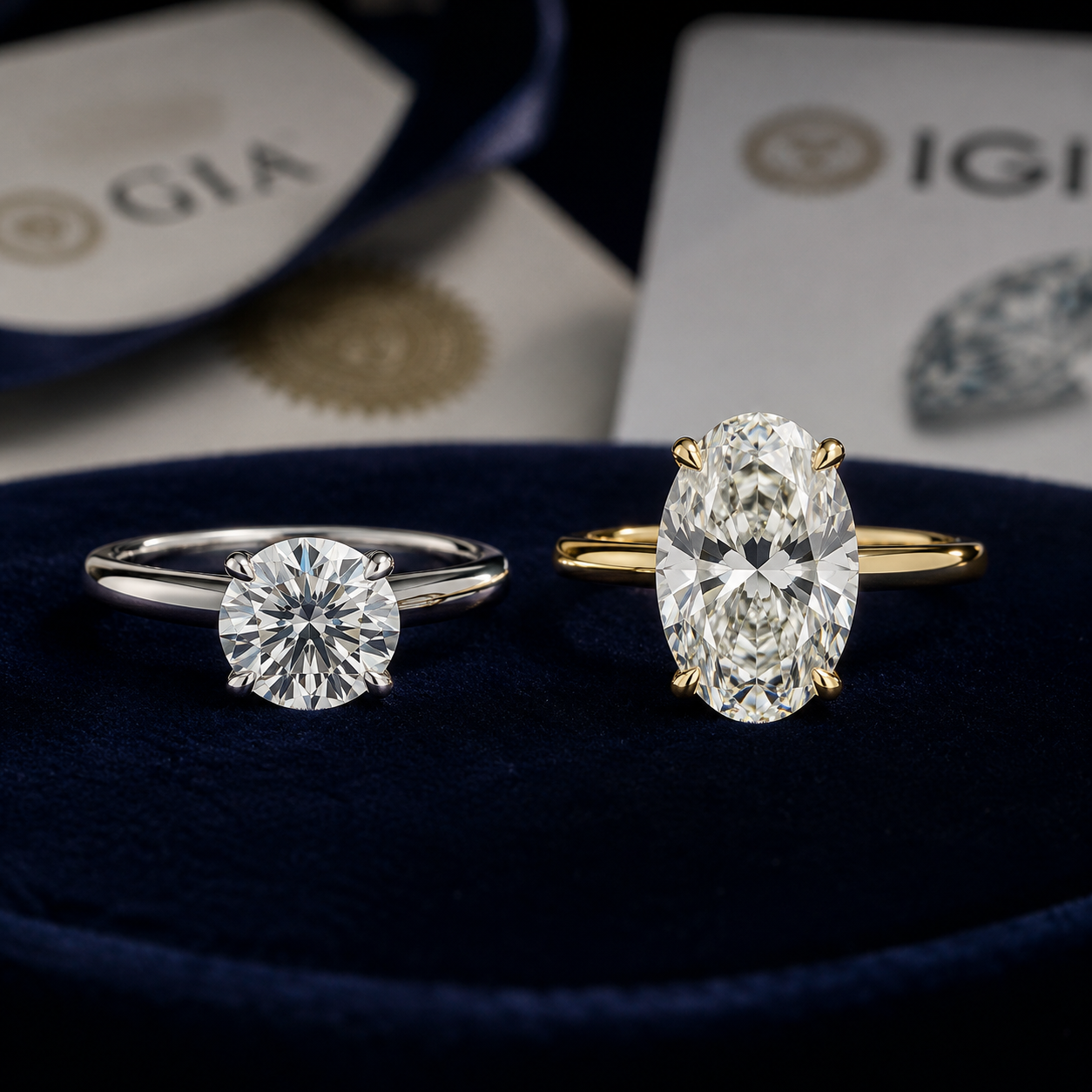
Shape affects price more than most buyers realize. A round brilliant diamond commands a higher price per carat than any other shape because the cutting process removes more of the original rough stone to achieve its precise proportions. Fancy shapes — oval, cushion, pear, emerald, marquise — typically cost 20 to 40 percent less per carat than a round of equivalent quality and grades. This is one of the most effective ways to get a larger, more impressive stone within a fixed budget.
The Metal Setting
The setting generally represents 10 to 20 percent of the total ring price. Platinum settings cost more than gold — typically 20 to 30 percent more — due to its density and the additional labor involved in working with it. Among gold options, 18k costs more than 14k, though the visual difference in everyday wear is minimal. The setting style also affects cost: a simple solitaire costs less to produce than an elaborate halo or pavé setting with many additional stones.
Lab-Grown Versus Natural Diamond
This is the factor that has most dramatically changed the engagement ring market in recent years. A lab-grown diamond is chemically, physically, and visually identical to a natural diamond. The difference is origin — one formed underground over billions of years, the other created in a controlled laboratory environment over several weeks. In 2026, a lab-grown diamond of the same specifications as a natural diamond costs 75 to 80 percent less. A buyer with a $5,000 budget who chooses lab-grown can access a stone that would cost $20,000 or more in natural. The decision comes down entirely to whether natural origin carries personal significance.
Certification
A certified diamond — graded by GIA or IGI — will always cost slightly more than an uncertified stone of ostensibly similar quality. That premium is worth every dollar. Without an independent grading certificate, you have only the seller's word for what you are buying. The certificate is not an optional extra. It is the proof of purchase.
Real Price Ranges by Budget in 2026
Here is an honest guide to what each budget level realistically gets you in the current US market.
$1,000 to $2,500
At this level, you are working with a lab-grown diamond or a small natural diamond under half a carat. A well-chosen lab-grown stone in the 0.7 to 1 carat range with good cut and color grades is entirely achievable here, set in 14k gold. This range produces genuinely beautiful rings — the key is prioritizing cut quality above everything else and choosing a simple, well-made setting.
$2,500 to $5,000
This is where the options open up considerably. A lab-grown diamond in the 1.5 to 2.5 carat range with excellent cut, G to H color, and VS2 clarity is well within reach in 14k or 18k gold. For natural diamonds, this budget supports a well-cut stone in the 0.7 to 0.9 carat range with strong grades. Many of the most beautiful engagement rings sold in the USA sit in this range.
$5,000 to $10,000
The national average sits in the lower end of this window. A natural diamond in the 1 to 1.5 carat range with excellent cut and G to H color is realistic here. Lab-grown buyers in this range can access stones of 2.5 carats and above in platinum or 18k gold settings. This budget also opens up more elaborate setting styles — three stone designs, halo settings, and pavé bands — without compromising on the center stone.
$10,000 and Above
At this level, a natural diamond of 1.5 to 2 carats with excellent grades across all four characteristics is achievable in any metal. For lab-grown buyers, this budget supports genuinely impressive stones of 3 carats or more. Custom design work, intricate settings, and premium platinum construction are all accessible here without tradeoff.
How to Get More Ring for Your Budget
These are the decisions that consistently produce the best value without any visible compromise.
Choose a fancy shape. Oval, cushion, pear, and marquise diamonds cost 20 to 40 percent less per carat than rounds of equivalent quality. The difference in brilliance is minimal in everyday wear.
Buy just under a carat milestone. Diamond prices jump sharply at half-carat, one-carat, 1.5-carat, and two-carat thresholds. A stone weighing 0.95 carats looks virtually identical to a one-carat stone on the hand and typically costs 15 to 25 percent less.
Optimize color to G or H. These grades appear completely colorless in virtually any setting and cost around 27 percent less than D or E color stones of the same specifications.
Choose SI1 clarity if it is eye-clean. Have your jeweler confirm the stone looks clean to the naked eye. If it does, the inclusions are entirely irrelevant to how the ring looks in real life.
Consider a simple setting. An excellent diamond in a clean four-prong solitaire setting will outshine a mediocre diamond in an elaborate halo. The stone is what people see. The setting is the frame.
Choose 14k over 18k gold. Both look identical in person. 14k is more durable for daily wear and costs meaningfully less.
The 1 Carat Diamond — What Does It Actually Cost?
The one-carat round brilliant is the most searched diamond purchase in the USA. Here is what it realistically costs in 2026.
A natural one-carat round brilliant with excellent cut, G color, and VS2 clarity from a GIA-certified stone will typically run between $4,500 and $6,500 for the stone alone, before setting. Add a well-made 14k solitaire setting and the total lands somewhere between $5,500 and $8,000 depending on the retailer.
A lab-grown one-carat round brilliant of the same specifications — excellent cut, G color, VS2 clarity, IGI certified — costs between $700 and $1,200 for the stone. With a 14k setting, the total typically falls between $1,200 and $2,000.
The visual result of both is identical. The price difference is entirely about origin.
The 2 Carat Diamond — What Does It Actually Cost?
Two-carat diamonds represent a significant price jump because stones of this size are considerably rarer in nature.
A natural two-carat round brilliant with excellent cut, G color, and VS2 clarity will typically cost between $18,000 and $26,000 for the stone. With a setting, total prices regularly exceed $22,000 to $30,000.
A lab-grown two-carat round brilliant of equivalent quality costs between $2,500 and $4,000 for the stone — roughly 85 percent less. With a quality setting, the total typically lands between $3,500 and $5,500.
For buyers whose primary goal is maximum visual presence, the lab-grown two-carat at this price point represents one of the most compelling values in the current market.
Questions to Ask Before You Set Your Budget
Before you commit to a number, these questions will help you spend it in the right place.
Does natural origin matter personally? If natural origin carries emotional or symbolic significance — the rarity, the geological history — that is a completely valid reason to choose a natural diamond. If it does not, lab-grown removes the single biggest budget constraint.
Which shape does she love? If she gravitates toward oval or cushion shapes, you will automatically access 20 to 40 percent more stone for the same money compared to round.
Will this ring sit alongside a wedding band? If so, a simple, slim profile in a consistent metal will stack far more elegantly than something elaborate.
How does she wear jewelry generally? Someone who wears jewelry actively and daily is better served by a durable, low-profile setting than by something delicate. A ring she can wear every day without anxiety is a better ring regardless of price.
Certification — Never Skip It
Every diamond you purchase should come with an independent grading certificate from GIA or IGI. These are the two organizations whose standards carry the most weight with serious buyers and reputable jewelers across the USA.
A certificate confirms the exact 4C grades, the dimensions, and the specific identifying characteristics of your stone. Without one, you are buying on trust alone. With one, you have documented proof of exactly what you paid for.
This applies equally to natural and lab-grown diamonds. Both GIA and IGI certify lab-grown stones. Never purchase either without a certificate.
|
Quick Reference — Engagement Ring Costs at a Glance Average engagement ring spend USA 2026 — $5,500 to $6,000 Natural 1 carat round brilliant (G, VS2, Excellent) — $4,500 to $6,500 stone only Lab-grown 1 carat round brilliant (G, VS2, Excellent) — $700 to $1,200 stone only Natural 2 carat round brilliant (G, VS2, Excellent) — $18,000 to $26,000 stone only Lab-grown 2 carat round brilliant (G, VS2, Excellent) — $2,500 to $4,000 stone only Cost of round vs. fancy shape — Fancy shapes 20 to 40% less per carat Cost of G vs. D color — G saves around 27% with no visible difference Salary rule — Ignore it entirely Certification to look for — GIA or IGI |
|---|
Every Budget Deserves a Beautiful Ring.
At Auvera Craft, whether you are working with $2,000 or $20,000, our team will help you understand exactly where your money goes and how to make every dollar count toward a ring she will love wearing every day.
SHOP ENGAGEMENT RINGS →
© 2026 Auvera Craft · Handcrafted Fine Jewelry · USA

