
Cart
0
AUVERA CRAFT
Handcrafted Fine Jewelry · Buying Guide · 2026
Diamond Ring Buying Guide
4Cs, Shapes, Metals and Budget Tips
A diamond ring is one of the most meaningful purchases you will ever make. This guide helps you understand exactly what you are buying — and how to get the most for your money.
Shopping for a diamond ring the first time can feel overwhelming. You open a website or walk into a store and immediately face a wall of unfamiliar terms — cut grades, clarity scales, carat weights, certification bodies. It feels like everyone around you already knows something you don't.
The truth is that diamond shopping becomes straightforward the moment you grasp a few foundational ideas. And once those ideas click, you will start to see how much of the confusion out there actually works in the seller's favor — not yours.
This guide walks through everything that genuinely matters: the four qualities that determine what a diamond is worth, the shapes available and what each one looks like on the hand, the metals you will choose between for the setting, and a realistic, no-nonsense approach to setting your budget.
The 4Cs — What They Are and Which One Matters Most
Every diamond anywhere in the world gets evaluated using the same four characteristics. These are known as the 4Cs — cut, color, clarity, and carat weight. Getting familiar with each one changes how confidently you shop.
Cut — The Most Important C
If there is one thing to take away from this entire guide, it is this: cut is what separates a diamond that looks alive from one that looks dull. It determines how effectively the stone pulls in light, bounces it around internally, and throws it back to your eye as brilliance and fire.
A stone with an outstanding cut and middling color or clarity grades will outperform a larger, better-graded diamond with a mediocre cut every single time. Cut is that important.
Cut grades are ranked from Excellent at the top, followed by Very Good, Good, Fair, and Poor. At Auvera Craft, every stone we select carries an Excellent or Very Good cut grade. Anything below that threshold is a tradeoff you will notice every time the ring catches the light.
Color — Less Visible Than Most People Expect
The diamond color scale runs from D, which is completely colorless, all the way to Z, which carries a visible yellow or brownish tint. The gap between any two neighboring grades — D and E, for example — is essentially invisible to the naked eye and barely detectable even under magnification.
For most shoppers, the G to H range hits the sweet spot. These stones face up colorless in nearly any setting while costing meaningfully less than the D, E, or F tier. Selecting a G color over a D color on an otherwise identical stone typically saves around 27 percent with no visible difference in real life.
One useful exception: if you are choosing a yellow gold setting, a slightly warmer stone in the H or I range can actually work in your favor. The warmth of the metal absorbs any trace of yellow in the stone rather than highlighting it.
Clarity — Most Inclusions Are Never Seen
Clarity refers to the presence of internal characteristics called inclusions — small crystals, fractures, or marks that formed as the diamond grew. The scale runs from Flawless at the top down through VVS1, VVS2, VS1, VS2, SI1, SI2, and finally the Included grades at the bottom.
Here is the practical reality most jewelers do not lead with: inclusions at VS2 and SI1 are almost universally invisible to the unaided eye. A trained grader with magnification equipment can locate them, but wearing the ring on your hand day to day, nobody ever will.
VS2 or SI1 is the ideal range for the vast majority of buyers. You get a stone that looks perfectly clean in everyday wear while preserving budget to spend on cut quality, size, or the setting itself.
Carat — Weight, Not Size
Carat is a unit of mass specific to gemstones — one carat equals 0.2 grams. It tells you how heavy the diamond is, not how large it will appear on the finger. A well-proportioned stone at a given carat weight will consistently look larger than a poorly cut stone of equal weight, because the cut controls how much surface area faces upward.
This is why two diamonds with matching carat weights can look surprisingly different when placed side by side. The proportions of the cut create genuinely different visual impressions.
One practical tip worth knowing: the diamond market prices stones in jumps at certain weight milestones — half a carat, a full carat, and so on up to two carats. A stone weighing 0.95 carats looks virtually identical to a one-carat stone on the finger and typically costs 10 to 25 percent less. Stopping just short of these milestones is one of the smartest moves any buyer can make.
Diamond Shapes — Which One Suits Her?
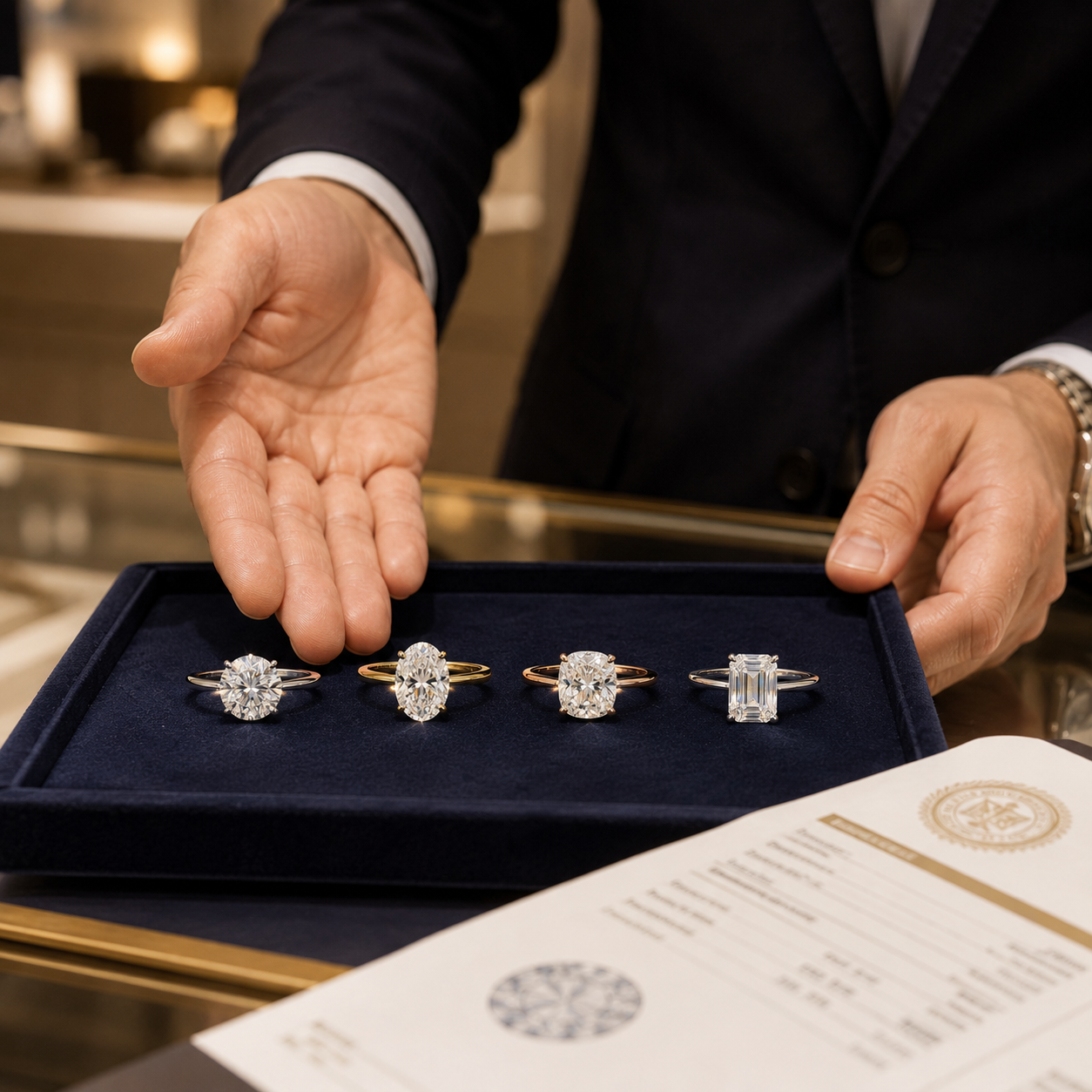
Shape refers to the outline of the stone when viewed from above. There is no objectively superior or inferior shape — it comes down entirely to personal style and what resonates with the person who will wear it every day.
Round Brilliant
No other diamond shape has maintained its dominance as consistently or as long as the round brilliant. Its 58 precisely arranged facets are engineered to return the maximum amount of light to the eye, producing a level of brilliance that other shapes approach but rarely equal. It is timeless, works on every hand, and remains the most universally flattering choice. It does command a higher price per carat than other shapes — achieving those precise proportions requires removing more of the original rough stone during cutting.
Oval
The oval cut has become the most-requested shape among buyers in the USA as of 2026. It delivers brilliance that rivals a round diamond, creates a lengthening effect on the finger that many wearers find flattering, and typically costs 20 to 30 percent less per carat than a round of comparable quality. Modern without veering into trend territory, it carries a staying power that makes it a strong choice for an engagement ring.
Cushion
A cushion cut pairs a square or rectangular outline with softly rounded corners and large, open facets that produce a warmer, more romantic kind of sparkle. It carries a gentle, vintage-adjacent character that suits partners who gravitate toward jewelry with warmth and personality rather than sharp, high-contrast brilliance.
Emerald
The emerald cut is rectangular with step-cut facets rather than the brilliant-style facets found on most other shapes. It produces a completely different visual effect — long, dramatic flashes of light rather than the scattered sparkle of a brilliant cut — and has a clean architectural quality that suits partners with confident, understated taste. Because of its open table, the emerald cut shows color and clarity more readily than other shapes, so quality grades matter more here than elsewhere.
Pear
The pear shape — pointed at one end and rounded at the other — is elongated and immediately distinctive. It creates a flattering, finger-lengthening effect similar to an oval but with more visual drama. Pear shapes are having a strong moment in 2026 and pair well with both minimalist solitaire settings and more elaborate designs.
Marquise
Long, narrow, and pointed at both ends, the marquise creates the most dramatic elongating effect of any shape. It makes a stone appear considerably larger face-up than its actual carat weight would suggest — a marquise consistently looks bigger than a round of the same weight. It suits partners who want jewelry that makes a clear statement.
Princess
The princess cut is a square shape with brilliant-style faceting that produces strong, high-contrast sparkle. It has a sharp, contemporary character that is entirely different from the soft curves of oval and cushion cuts. Princess cut diamonds tend to be more affordable than rounds of equivalent carat weight.
Choosing the Right Metal for Your Setting
The metal you select for the setting shapes how the diamond reads visually, how the ring holds up over years of daily wear, and how it will eventually sit alongside a wedding band. Here is an honest look at each option.
Yellow Gold
Yellow gold is the most traditional choice and currently the most popular metal for engagement rings across the USA. Its warmth pairs beautifully with diamonds, especially in the G, H, and I color range where a slightly warmer stone benefits from rather than conflicts with the metal tone. 14k yellow gold delivers the best combination of durability and rich color for everyday wear. 18k carries a deeper, richer tone but is marginally softer.
White Gold
White gold offers a clean, modern look that many buyers prefer for showcasing a colorless diamond. It is produced by alloying gold with white metals and finished with rhodium plating to achieve a bright, mirror-like surface. That plating will need to be refreshed every few years to maintain its appearance — a quick, low-cost service at any jeweler, but worth factoring in upfront.
Rose Gold
Rose gold gets its warm, romantic hue from its copper alloy content, and that same copper makes it genuinely durable for daily wear. It pairs particularly well with oval, pear, and cushion cut stones and suits partners who want something that feels personal and distinctive. Rose gold has maintained steady popularity and shows no signs of going out of style.
Platinum
Platinum is the most durable and most expensive metal available for fine jewelry. It is naturally white and requires no plating — unlike white gold, it will never reveal a yellow undertone. Over time it develops a soft patina that many wearers come to love. Platinum is the right choice for buyers who want the most long-lasting setting possible and are comfortable with the premium price it carries.
How to Set a Budget — The Honest Version
You have probably encountered the old rule that an engagement ring should cost two or three months of salary. That rule originated from a diamond industry marketing campaign several decades ago and has no basis in any financial principle or practical reality. Disregard it entirely.
The average diamond engagement ring purchase in the USA in 2026 falls between $5,500 and $6,000. That said, informed buyers are regularly putting together rings that look significantly better for $3,000 to $4,000 by understanding what actually drives value.
Here are the decisions that save the most money without any visible compromise:
Choose a fancy shape over round. Oval, cushion, and pear diamonds typically cost 20 to 35 percent less per carat than a round of equivalent quality. The difference in brilliance is minimal in real-world wear.
Buy just under a weight milestone. A 0.95 carat stone looks virtually the same as a full carat stone on the finger and costs noticeably less. The same principle holds at 1.45 carats versus 1.5.
Optimize to G or H color. These grades face up colorless in virtually any setting and cost around 27 percent less than D or E color stones of the same specifications.
Choose SI1 clarity if the stone is eye-clean. Have your jeweler confirm the stone looks clean without magnification. If it does, the inclusions are entirely irrelevant to how the ring looks on the hand.
Consider lab-grown. A lab-grown diamond with the same specifications as a natural diamond costs 75 to 80 percent less. It is chemically and visually identical. The decision comes down entirely to whether natural origin matters to you personally.
Certification — Always Buy a Certified Diamond
Every diamond you consider should come with a grading report from a reputable independent laboratory. In the USA, the two organizations whose reports carry the most weight with serious buyers and reputable jewelers are GIA and IGI. Their standards for accuracy and consistency have established them as the benchmark for the entire industry.
A certificate tells you precisely what you are purchasing. It confirms the 4C grades, the dimensions, and the identifying characteristics of that specific stone. Without one, you have only the seller's word for the quality of what you are buying.
Never purchase a diamond without a GIA or IGI certificate. This is the single most important practical rule in diamond buying.
|
Quick Reference — Diamond Buying at a Glance Most important of the 4Cs — Cut Best cut grades to buy — Excellent or Very Good Best color range for value — G to H Best clarity range for value — VS2 or SI1 Most popular shape in USA 2026 — Oval Most brilliant shape — Round Brilliant Best value shapes — Oval, Cushion, or Pear Most durable metal — Platinum Most popular metal in 2026 — Yellow Gold Average engagement ring spend USA 2026 — $5,500 to $6,000 Certification to look for — GIA or IGI The salary rule — Ignore it entirely |
|---|
Ready to Find Your Diamond?
At Auvera Craft, every diamond ring we create is built around stones we have personally reviewed and verified. We work with GIA and IGI certified diamonds across every shape, cut, and metal — and we walk you through every decision before you make it.
SHOP DIAMOND RINGS →
© 2026 Auvera Craft · Handcrafted Fine Jewelry · USA

