
Cart
0
|
AUVERA CRAFT Handcrafted Fine Jewelry ·Jewelry Guide · 2026 |

Ring Size Guide
How to Find the Right Fit Before You Buy
One small number stands between a perfect proposal moment and an awkward one. This guide helps you get it right.
Nobody talks about ring sizing until they absolutely have to. Then suddenly it becomes the most stressful part of buying a ring.
Here is the thing — it does not have to be. Whether you are shopping for an engagement ring, a promise ring, or a gift for someone you love, finding the right size is genuinely simple once you know what to look for.
This guide walks you through everything. Average sizes for women and men. A sizing reference. Three ways to measure at home. What to do when you cannot measure at all. And how to handle the common situation of landing right between two sizes.
By the end of this, you will know exactly what to buy.
Starting Point — What Size Should You Expect?
Before reaching for a measuring tape, it helps to understand where most people land.
Jewelry industry data from 2026 shows that women across America most commonly purchase ring sizes somewhere in the 5 to 7 range, with the number 6 sitting right in the middle of that window. Around 68 percent of all women's engagement rings bought in the USA fall between a 5.5 and a 7. If you are planning a surprise proposal with no measurement to rely on, you are statistically most likely to land correctly somewhere in that range.
For men, the numbers shift noticeably. Most male ring purchases across the US fall somewhere between an 8 and an 11, with 9 and 10 being the two most frequently bought sizes. The number 9 represents roughly the midpoint of the male average.
Keep in mind these figures are a starting point only — not a guarantee. Finger size varies from person to person and even between someone's two hands.

Understanding US Ring Sizes
Ring sizes in the USA follow a numerical scale. Rather than relying on millimeter charts — which vary slightly from source to source — the most dependable thing you can do is walk into any jewelry store and ask to be sized on a mandrel. This instrument gives you a precise reading in under a minute and removes all guesswork.
As a general reference: women's sizes in the US typically begin around a 4 at the smaller end and extend upward to a 9 or beyond, with 6 sitting at the midpoint. Men's sizes generally start around a 7 and run up to a 13 or higher, with 9 representing the most common individual size.
Use these midpoints as your anchor and adjust based on how the person's hands compare to average.
One principle applies regardless of where you land on the scale — if you find yourself between two sizes, always go with the larger of the two. A ring that fits slightly loosely is a simple fix. A ring that cannot clear the knuckle is a problem.
Women's Ring Size Guide

Most women in the USA wear somewhere in the 5 to 7 range, though meaningful variation exists. Factors like body build, age, which hand is being measured, and even the season of the year can all shift finger size.
A few things particularly worth knowing when buying a ring for a woman:
Left Hand Sizing
In the USA, most people choose to wear their engagement ring on the left hand. This hand tends to run slightly smaller for most people compared to the right. If any previous ring sizing happened on the right hand, dropping half a size typically brings you closer to the correct fit for the left.
Band Width Affects How a Ring Feels
A slim, narrow band and a wide bold band carrying the same size label will sit very differently on the finger. Wider bands press more surface area against the skin and naturally feel tighter. When choosing any style with a wide profile, going up half a size will usually give a more comfortable result for daily wear.
When Buying Without Any Measurement
If there is genuinely no way to measure and no ring to borrow, start at a size 7. This sits just slightly above the national average, which means the ring will slide on cleanly in the moment — and adjusting it smaller afterward is a more straightforward process than making it larger.
Men's Ring Size Guide

Men's ring sizes in the US begin around a 7 at the lower end and extend up to a 13 or beyond. The most purchased range falls between 9 and 11, with size 9 being the single most common choice.
Men's rings tend to be wider than women's — most wedding bands for men run between 6 and 8 millimeters across. A wider profile means more contact between the ring and the finger, which creates a tighter feel compared to a slimmer ring of the same labeled size. Anyone selecting a wide or bold band should think about going half a size larger than their usual measurement to maintain comfort.
One misconception worth clearing up: general body size is not a reliable predictor of ring size. Someone tall or broad-shouldered does not automatically have larger fingers. Finger width is determined by bone structure, which varies on its own regardless of height or weight. Direct measurement is the only approach that gives you an accurate answer.
When no measurement is possible and you are buying as a surprise, size 10 is the most practical starting point for most men.
Three Ways to Measure Ring Size at Home

A jewelry store visit is not required for an accurate measurement. All three of the following approaches work reliably from home.
The Paper Strip Method
Find a thin strip of paper — roughly half an inch wide — and loop it around the finger you intend to wear the ring on, positioning it at the base of the finger rather than the widest point. Mark where the paper meets itself, then lay it out flat and measure that distance in millimeters. The number you get is your finger circumference. Look that figure up against any US ring size circumference chart to find your size.
The Ring Tracing Method
This approach works well when trying to determine a partner's size discreetly. Pick up a ring they already wear comfortably on the finger in question and trace the inside of it onto a piece of paper. Measure the diameter of that traced circle in millimeters — the distance straight across the inside of the ring — then match that figure to a US ring diameter reference to identify the size.
Getting Sized by a Jeweler
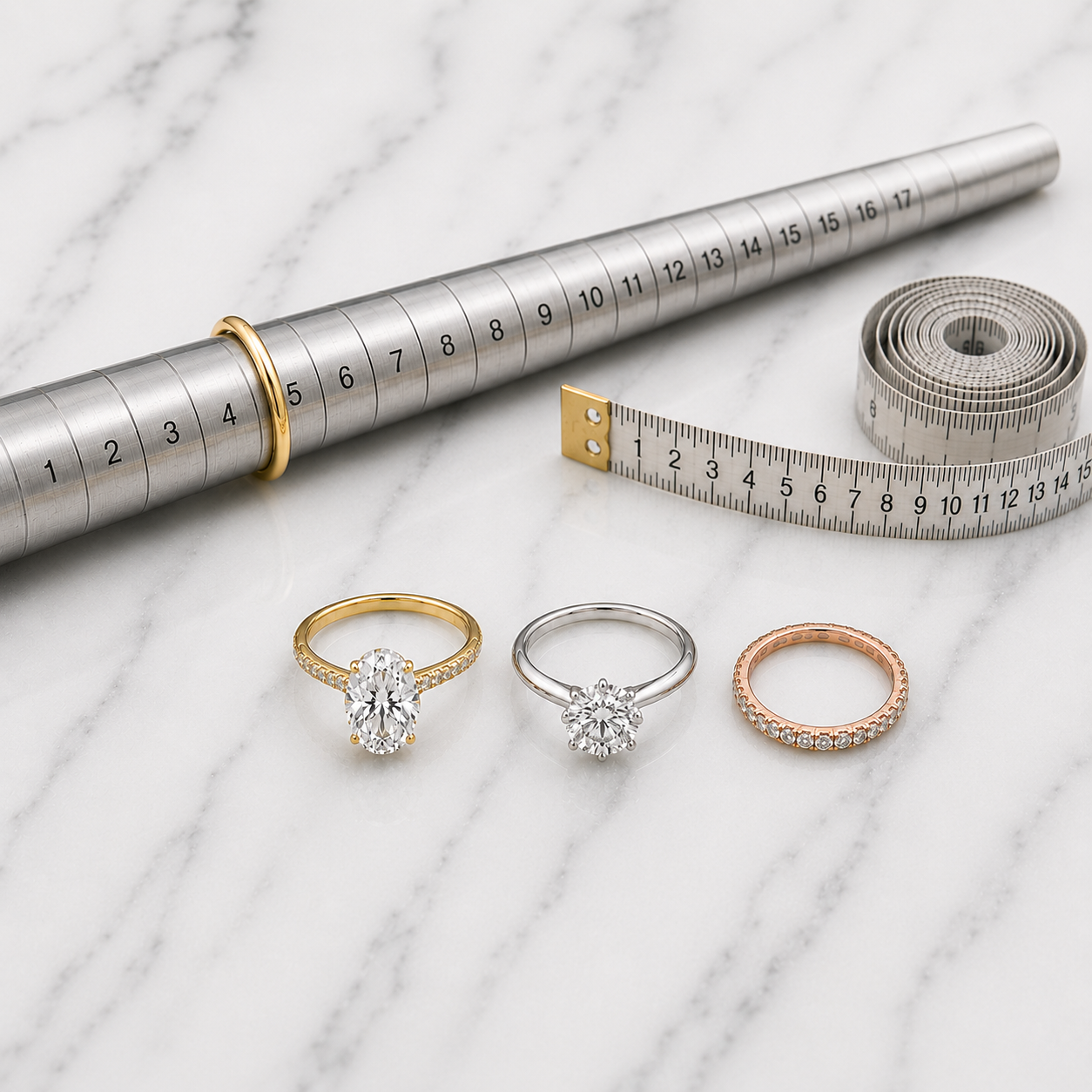
Every reputable jewelry store has a ring sizing mandrel on hand — a tapered metal tool with size markings. Sliding a ring or a finger onto this tool gives a precise reading instantly. If you are visiting a store to browse or purchase, always ask to be sized before making a final decision.
Tips for the Most Accurate Reading

Finger size fluctuates. It responds to temperature, hydration levels, and the time of day. A reading taken on a cold morning will differ from one taken on a warm afternoon after activity. Here is how to get the most consistent result:
Timing Your Measurement
The middle of the day — somewhere around early to mid-afternoon — tends to give the most stable reading. Fingers are generally at their average size during this window, past any morning tightness but before the swelling some people experience by evening.
Weather and Temperature
Cold temperatures narrow fingers. Heat expands them. Avoid measuring right after stepping in from cold air outside, or immediately following any kind of physical exertion. An ordinary comfortable indoor temperature gives you the most reliable baseline.
Take More Than One Reading
Measuring on two or three separate days, at different times of day, gives you a number you can rely on. When your readings differ, go with the larger figure.
Knuckle Versus Base
The ring must pass over the knuckle to reach the base of the finger — and on many hands, the knuckle is noticeably wider. If this applies to you, measure at both points and choose a size that sits somewhere between the two measurements.
What to Do When You Are Between Sizes
This situation comes up more often than most buyers expect. Here is a simple way to decide:
— For thin or standard width bands — the smaller of the two sizes usually gives the better fit.
— For wide or chunky bands — the larger size will feel more comfortable day to day.
— For rings worn all day every day — lean slightly larger to give your finger room for the natural size changes that happen throughout the day.
When you are genuinely not sure which way to go, choose the larger option. Reducing a ring by half a size is a routine job for any jeweler and costs very little. Increasing a ring's size requires adding metal and is typically more involved.
A Note on Ring Resizing

Most ring styles can be adjusted by one to two sizes in either direction without leaving any visible evidence of the change. At Auvera Craft, every ring we create can be reviewed for resizing potential — and our team is always happy to advise on what is practical for a given design before you commit to buying.
There are some styles that present more of a challenge. Any ring where stones are set all the way around the band without interruption — a full eternity band being the clearest example — cannot be resized without detaching and re-setting those stones. This increases both the cost and the time involved. For these particular styles, arriving at the correct size before placing the order matters considerably more than it does for a standard setting.
|
Quick Numbers to Remember Women's most common ring size in the USA — Size 6 Typical range for women — Size 5 to Size 7 Men's most common ring size in the USA — Size 9 Typical range for men — Size 8 to Size 11 Best starting size for a surprise proposal for women — Size 7 Best starting size for a surprise proposal for men — Size 10 When landing between two sizes — Always choose the larger Best time of day to measure — Mid-afternoon |
Got questions? Our team is happy to walk you through it personally.
|
Still Not Sure? We Can Help. At Auvera Craft, getting the fit right matters to us — because a ring that sits perfectly on the finger is a completely different experience from one that does not. Our team is available to guide you through sizing personally, whether you are buying for yourself or planning a surprise for someone you love. |
© 2026 Auvera Craft · Handcrafted Fine Jewelry · USA

