
Cart
0
|
AUVERA CRAFT Handcrafted Fine Jewelry · Diamond Guide · 2026 |

Lab Grown vs. Natural Diamonds 2026
Honest Guide for U.S. Buyers
Picking a diamond in 2026 looks nothing like it did ten years ago. A decision that once had a single obvious answer now comes with options, trade-offs, and a price gap that genuinely changes what is possible for most couples.
You have probably already seen the numbers floating around online. Lab-grown diamonds cost a fraction of what natural ones do. But does that mean you should automatically choose one over the other? Not necessarily. The right answer depends entirely on what you personally value most in a ring.
Let us break it all down clearly.
What Exactly Is a Lab Grown Diamond?
A lab-grown diamond is not a fake diamond, a diamond simulant, or cubic zirconia. It is a real diamond — grown inside a controlled laboratory environment using technology that recreates the exact pressure and heat conditions found deep beneath the Earth's surface.
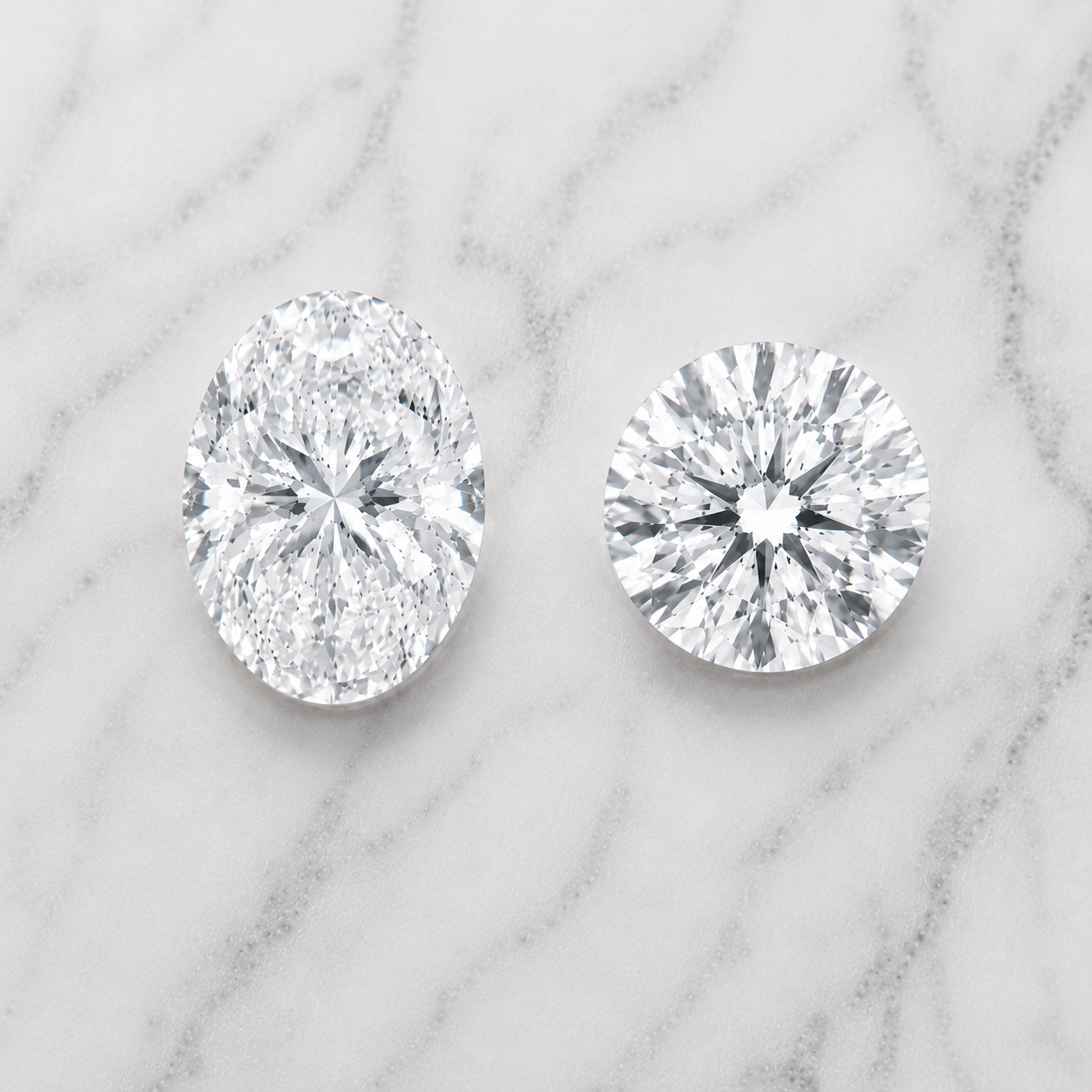
The end result is a stone with the same chemical makeup, the same crystal structure, the same hardness rating of 10 on the Mohs scale, and the same light performance as any diamond pulled from the ground. Even trained gemologists using professional equipment often cannot distinguish between the two without looking for very specific growth patterns.
In 2018 the Federal Trade Commission officially removed the word "natural" from the definition of a diamond in the United States. Legally and scientifically, both stones carry equal standing.

✦ LAB GROWN
Lab Grown Diamond Rings
The Budget Advantage Is Enormous
Numbers tell this story better than words. Here is where prices currently stand across the U.S. market in 2026:
| Stone | Natural Diamond | Lab Grown Diamond |
| 1 Carat | $4,500 – $6,500 | $700 – $1,200 |
| 2 Carat | $18,000 – $24,000 | $2,800 – $4,200 |
| 3 Carat | $40,000 – $70,000 | $3,500 – $6,000 |
A couple working with a $5,000 budget faces a very different set of choices depending on which direction they go. With a natural diamond, that budget gets you somewhere around a 0.8 to 1 carat stone in a modest setting. With a lab-grown diamond, that same $5,000 could secure a 1.8 to 2.2 carat stone in an excellent setting with money to spare.
More Americans Are Choosing Lab Grown
Industry data from The Knot shows that lab-grown diamonds now account for over 61 percent of all engagement ring center stones purchased across the United States in 2026. Just two years earlier that figure sat at 52 percent. The average carat size of lab-grown center stones has climbed to 2.45 carats — an 87 percent jump compared to 2019 figures. Couples are not just saving money. They are using those savings to buy significantly larger, higher quality stones than they ever could have afforded otherwise.
The Honest Drawbacks
Resale value is the biggest practical concern with lab-grown diamonds. The secondary market for these stones is limited, and most resellers currently offer somewhere between 10 and 20 percent of the original purchase price. Natural diamonds typically recover between 20 and 60 percent of retail value when resold.
Beyond finances, some buyers — particularly those from older generations — attach deep personal significance to the idea of a stone formed naturally inside the Earth. That emotional dimension is real and completely valid.
Best for: Buyers whose priority is getting the largest, most visually impressive diamond their budget allows, with no intention of reselling.

✦ NATURAL
Natural Diamond Engagement Rings
A Stone With a Billion Year Story
Every natural diamond carries a timeline that no laboratory can replicate. These stones crystallized between one and three billion years ago under extraordinary conditions at depths most drilling equipment cannot even reach. Fewer than one percent of diamonds that begin forming underground ever make it to the surface in gem quality. That scarcity is geological fact, not advertising copy.
For many buyers, knowing that the stone in their ring has been on this Earth longer than human civilization adds something no certificate can quantify. It is a feeling, and feelings matter when choosing something meant to be worn for a lifetime.
Stronger Resale Performance
Natural diamonds are not a reliable investment vehicle by any standard financial measure. However, if the possibility of reselling matters to you even slightly, natural stones hold a clear advantage. Larger natural diamonds in excellent quality grades have historically maintained meaningful portions of their retail value, particularly when accompanied by respected certifications from GIA or IGI.
Price Stability in 2026
Natural diamond prices went through a period of mild correction between 2022 and 2024 but have since stabilized. Unlike lab-grown stones which saw dramatic price drops as production scaled up, the natural diamond market in 2026 reflects steady, predictable pricing. The price you see today is unlikely to drop significantly in the near future.
The One Real Downside
Size and quality for the money. A natural diamond will always deliver a smaller stone at any given price point compared to its lab-grown equivalent. You are paying a premium for geological rarity, provenance, and a stronger resale history. Whether that premium feels justified is something only you can decide.
Best for: Buyers who place personal importance on natural origin, want the strongest possible resale position, or feel that rarity adds meaning to the ring.

A Direct Comparison
| Lab Grown Diamond | Natural Diamond | |
| Price | 75–85% less expensive | Standard market pricing |
| Look and Feel | Identical | Identical |
| Durability | 10 Mohs | 10 Mohs |
| Grading | GIA or IGI certified | GIA or IGI certified |
| Resale Recovery | 10 to 20 percent | 20 to 60 percent |
| Natural Rarity | Produced in weeks | Formed over billions of years |
| Environmental Impact | No mining required | Mining involved |
| 1 Carat Price 2026 | $700 to $1,200 | $4,500 to $6,500 |

Making the Final Decision
Think about what genuinely matters to you as a couple — not what anyone else thinks you should value.
A lab-grown diamond makes complete sense if getting the most visually stunning stone within your budget is the priority, and if you view the ring as a lasting symbol of your relationship rather than a financial asset.
A natural diamond makes complete sense if the origin of the stone carries personal meaning, if you want the security of better long-term value retention, or if knowing the diamond took billions of years to form adds something to what the ring means to you.
At Auvera Craft, our team helps couples navigate this decision every day. We carry both lab-grown and natural diamonds across a wide range of shapes, sizes, and settings — because we genuinely believe the best ring is the one that fits your life, your values, and your budget.
There is no wrong answer here. There is only the answer that is right for you.

Got questions? Our team is happy to walk you through it personally.
|
Find Your Perfect Diamond at Auvera Craft We carry both lab-grown and natural diamonds across a wide range of shapes, sizes, and settings. Our team is here to help you find the one that fits your life, your values, and your budget. SHOP DIAMOND RINGS → |
© 2026 Auvera Craft · Handcrafted Fine Jewelry · USA
