
Cart
0
AUVERA CRAFT
Handcrafted Fine Jewelry · Diamond Clarity Guide · 2026

Is VS1 or VS2 Better for a Diamond? Easy Guide to Choosing the Best Clarity
A practical, human-friendly guide to VS1 vs. VS2, eye-clean diamonds, price, shape, and what actually matters when you buy
Quick Summary
If you're comparing a VS1 and a VS2 diamond and wondering which one is better, the honest answer is: VS1 is the higher clarity grade, but VS2 can be the better buy. The difference is based on how easily a trained grader can see the diamond's inclusions under 10× magnification. GIA places both grades in the Very Slightly Included category, with VS1 inclusions described as difficult to see and VS2 inclusions as somewhat easier to see under magnification. GIA's official diamond clarity guide explains the full grading scale.
That technical difference does not automatically translate into a visible difference when the diamond is worn. Many VS2 diamonds can look completely clean to the naked eye, while some VS1 diamonds can still show a characteristic in a particular location or under certain viewing conditions. GIA also explains that clarity grading considers the size, number, position, nature, and relief of clarity characteristics, so the label alone never tells the whole story. See GIA's diamond quality factors for the grading framework.
For many engagement-ring shoppers, the smartest approach is to compare the actual stones. If a VS2 looks eye-clean, has a strong cut, and costs meaningfully less than a comparable VS1, the lower grade may leave more room in the budget for carat weight, color, or a setting you like better.
Key Takeaways
• VS1 ranks above VS2 on the GIA clarity scale.
• VS1 inclusions are generally harder to see under 10× magnification than VS2 inclusions.
• A VS2 diamond can still be eye-clean and look excellent in everyday wear.
• Clarity is not the same as sparkle. Cut quality has a major influence on a diamond's light performance.
• Inclusion location matters. A tiny inclusion near the center can be more noticeable than a similar characteristic near the edge.
• Step-cut shapes such as emerald and Asscher can make clarity characteristics easier to notice because of their broad, open facets.
• If the VS1 premium is large and you cannot see a practical visual difference, VS2 may offer better overall value.
• Always compare the grading report and the actual diamond rather than choosing only from the clarity letters.
Quick Answer:
VS1 is technically better, but VS2 is often the better value. If two diamonds have similar cut, color, carat weight, and proportions, VS1 will have the higher clarity grade because its defining inclusions are more difficult to see under 10× magnification. But that does not mean the VS1 will look noticeably better on your finger.
For an engagement ring, a well-cut VS2 that is eye-clean can be an excellent choice. You are unlikely to benefit from paying a large premium for VS1 if the extra clarity cannot be seen without magnification. The exception is when the VS2 has a distracting inclusion, the diamond is unusually large, or the shape makes inclusions easier to notice. In those situations, VS1 can provide useful peace of mind.
Who Is This Guide For?
This guide is for anyone standing between two diamond listings and seeing something like VS1 vs. VS2 while wondering whether the extra clarity is actually worth the money.
It is especially useful if you are:
- Buying an engagement ring for the first time
- Comparing two diamonds with similar carat, color, and cut
- Trying to stay within a fixed engagement-ring budget
- Shopping for a lab-grown or natural diamond
- Unsure what “eye-clean” really means
- Considering a round, oval, cushion, emerald, Asscher, pear, or marquise diamond
- Wondering whether VS1 will look noticeably better than VS2
- Trying to decide whether the money saved on clarity should go toward a larger diamond or better cut
Introduction
Diamond shopping has a funny way of turning a simple question into a spreadsheet.
You start with “I want a beautiful engagement ring.” Then you see D, G, H, VS1, VS2, SI1, 1.00 carat, 1.02 carat, Excellent cut, polish, symmetry, fluorescence—and suddenly you are comparing tiny differences that you may never notice once the ring is actually on a hand.
VS1 and VS2 are a perfect example.
On paper, VS1 sounds like the obvious winner. It sits one step above VS2, so it is natural to assume that the higher grade must look cleaner, brighter, and more impressive. But diamond clarity does not work quite that simply.
GIA grades clarity by examining characteristics under 10× magnification. GIA's clarity guide also explains how inclusion size, position, relief, nature, and quantity affect the grade. The grade is influenced by the size, number, position, nature, and relief of those characteristics. In other words, two diamonds with the same clarity grade can have very different inclusion patterns, and two adjacent grades can look remarkably similar without magnification.
That is why the practical question is not only “Which grade is higher?” It is “Which diamond looks clean to me, performs well, and makes the most sense for my budget?”
Once you look at VS1 and VS2 that way, the decision becomes much easier.
What Does VS1 Mean in Diamond Clarity?
VS1 stands for Very Slightly Included 1. It is one of the two grades in the Very Slightly Included category, sitting above VS2 and below VVS2 on the GIA clarity scale.
According to GIA, VS1 inclusions are minor and difficult for a skilled grader to see under 10× magnification. That does not mean the diamond has no inclusions. It means the characteristics are sufficiently subtle that they require effort and magnification to locate and evaluate.
In practical shopping terms, VS1 is a high clarity grade. It is commonly chosen by buyers who want a strong clarity specification without moving all the way into VVS or Flawless territory.
But there is an important catch: VS1 does not guarantee a diamond will look better than every VS2. A particular VS1 can have a characteristic in a visible location, while a particular VS2 may have its inclusion tucked near the edge or hidden by the setting.
What Does VS2 Mean in Diamond Clarity?
VS2 stands for Very Slightly Included 2. It is one step below VS1 on the GIA clarity scale.
GIA describes VS2 inclusions as minor characteristics that are somewhat easier for a skilled grader to see at 10× magnification than those in VS1 diamonds. Again, this is a grading distinction under magnification, not a statement that the diamond will necessarily look flawed when you wear it.
This is where VS2 becomes interesting for value-focused buyers.
Many VS2 diamonds can appear clean without magnification. GIA notes that many diamonds down to VS2—and in some cases even SI1—do not have inclusions that are easily visible to the unaided eye. That creates an opportunity: you can sometimes buy a diamond that looks excellent in real life without paying for a higher clarity grade that is mainly visible on the grading report.
VS1 vs. VS2: What Is the Actual Difference?
| Factor | VS1 | VS2 |
|---|---|---|
| Clarity position | Higher | One grade below VS1 |
| Inclusions under 10× | Generally more difficult to see | Generally somewhat easier to see |
| Naked-eye appearance | Often eye-clean | Often eye-clean, but must be checked individually |
| Typical price | Usually higher | Usually lower |
| Best advantage | Extra clarity margin and peace of mind | Potentially stronger value |
| Smartest choice | When the stone's appearance or size justifies it | When it looks clean and saves meaningful budget |
The table gives you the basic idea, but there is one sentence worth remembering: clarity grades describe the diamond under a grading process; your eyes experience the finished diamond.
Can You See the Difference Between VS1 and VS2 With the Naked Eye?
Sometimes, but often you cannot.
This is one of the most important points in the entire VS1 vs. VS2 conversation. A clarity grade is assigned using magnification and a standardized grading process. Your engagement ring, however, is normally viewed from a much greater distance and under changing real-world lighting.
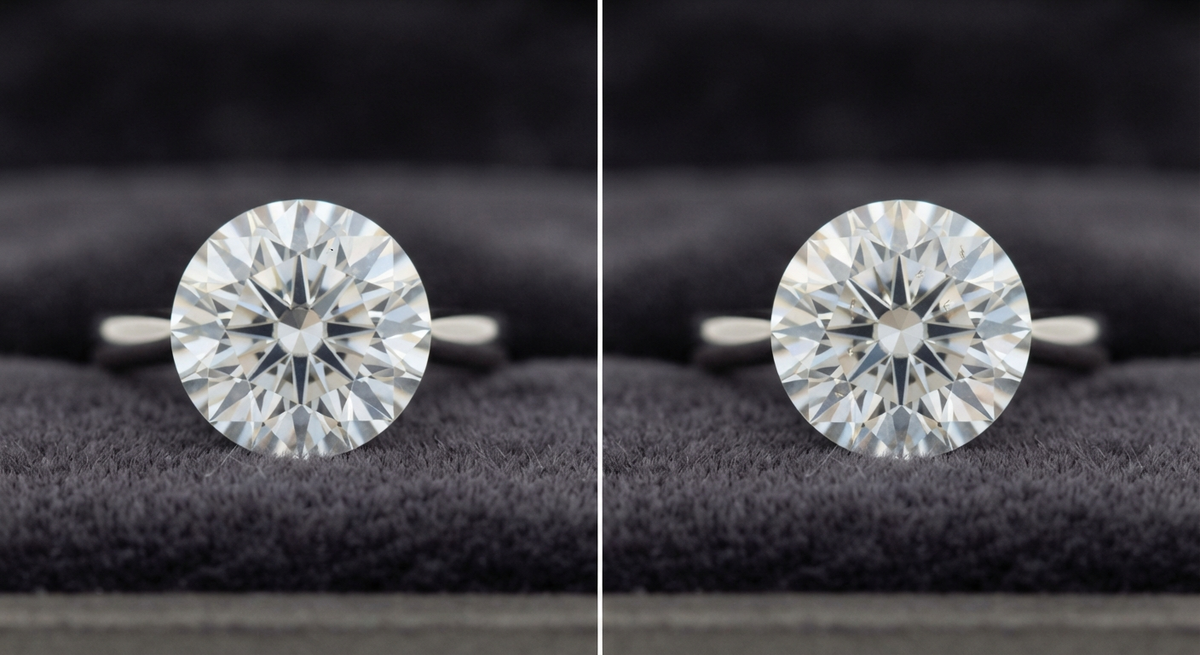
If both stones are eye-clean, the difference between them may be effectively invisible during normal wear. You could place a VS1 and a VS2 side by side, look at them from arm's length, and find it difficult to tell which is which.
That does not make the grades meaningless. The grades still document differences in clarity characteristics and rarity. It simply means that the higher grade does not always create a proportionate visual improvement.
This is why I would rather compare two actual diamonds than blindly choose “VS1” every time.

What Does “Eye-Clean” Mean?
“Eye-clean” is a useful shopping term, but it is not a formal GIA clarity grade.
GIA describes eye-clean as an industry term for a diamond whose inclusions cannot be seen with the naked eye. The important word is seen. A diamond can have inclusions that are clearly marked on a report and still look beautifully clean when you simply look at the ring.
There is also no universal guarantee that every VS2 is eye-clean or that every VS1 is automatically invisible. People have different eyesight, diamonds have different inclusion types, and viewing conditions change.
So if a seller tells you a stone is eye-clean, treat that as useful information—but still look at the actual diamond or ask for clear video and images under realistic conditions.
Why Inclusion Location Matters More Than the Grade Suggests
Imagine two diamonds with tiny inclusions of roughly similar size.
In Diamond A, the inclusion sits close to the outer edge where the setting may partly hide it. In Diamond B, a similar characteristic sits close to the center of the table. The second diamond may be easier to notice even if the difference sounds tiny on paper.
GIA explains that the position of a clarity characteristic can affect its impact on the grade. Relief also matters: a darker or more contrasting inclusion can be easier to notice than a pale, low-contrast one.
This is why the clarity plot on a grading report is worth looking at. It gives you a visual map of the characteristics the grader used when assigning the clarity grade.
Does Diamond Shape Change the VS1 vs. VS2 Decision?
Absolutely. Shape is one of the reasons you should not use a single clarity rule for every diamond.
Round Brilliant Diamonds
Round brilliant diamonds are generally forgiving because their faceting creates lots of movement, contrast, and sparkle. A well-cut round VS2 can be an excellent value if it is eye-clean.
Oval, Pear, and Marquise Diamonds
These elongated shapes can hide certain inclusions well because of their facet patterns, but the exact stone still matters. With pear and marquise diamonds, pay attention to the pointed ends and the overall clarity plot.
Cushion Diamonds
Cushion cuts can vary considerably in faceting style. Some have crushed-ice-like patterns, while others show larger, more organized facets. The visual personality of the stone can influence how noticeable an inclusion feels.
Emerald and Asscher Cuts
These are the shapes where I would be more cautious about dropping clarity just to save money. Their step-cut facets create broad, open windows into the diamond. Because the pattern is less busy than a brilliant cut, inclusions can be easier to notice.
That does not mean every emerald-cut diamond needs to be VS1 or higher. It means you should actually inspect the stone before deciding that VS2 is enough.

Is VS1 Worth More Money Than VS2?
It can be, but the answer depends on the actual diamonds being compared.
Higher clarity grades are generally rarer, and rarity influences diamond pricing. That means a VS1 diamond will commonly cost more than a comparable VS2. But “more expensive” and “better value” are not the same thing.
Suppose you have two diamonds with similar carat weight, color, cut, polish, symmetry, and proportions. The VS1 costs significantly more, while the VS2 looks just as clean to you. In that situation, the VS2 may be the more sensible purchase.
You could put the saved money toward something you can actually see: a better cut, a slightly larger face-up size, a preferred diamond shape, or a more refined setting.
On the other hand, if the price difference is small and you strongly prefer the reassurance of the higher clarity grade, VS1 can be perfectly reasonable. There is nothing wrong with paying for a specification you personally value.
What Is More Important: VS1/VS2 Clarity or Diamond Cut?
For many shoppers, cut deserves more attention than chasing the highest clarity grade.
Cut affects how the diamond interacts with light, including its brightness, fire, and scintillation. A beautifully cut VS2 can look far more lively than a poorly cut diamond with a higher clarity grade.
That is why I would not automatically trade down in cut just to move from VS2 to VS1.
If the choice is:
- Excellent cut + eye-clean VS2
- Average cut + VS1
I would investigate the first diamond very seriously. The VS1 label sounds impressive, but it cannot rescue a diamond that does not perform well visually.
GIA's buying guidance also emphasizes that diamond quality is about the interaction of the 4Cs rather than one grade in isolation. Read GIA's diamond buying guide.
When VS2 Is Probably the Smarter Choice
VS2 can make a lot of sense when:
- The diamond is visibly clean without magnification.
- The inclusion is small, low-contrast, and not in an obvious position.
- The diamond has a strong cut and attractive proportions.
- You would rather spend the savings on carat, color, or the setting.
- You are buying a brilliant-cut shape that naturally disguises minor inclusions well.
- The VS1 upgrade creates a large price jump without a visible improvement.
This is especially useful for buyers who care about the final ring rather than the prestige of the specification sheet.
When VS1 Is Probably Worth Considering
VS1 can be a better choice when:
- The VS2 has a characteristic you can actually see.
- You are choosing a large diamond where clarity characteristics may be easier to notice.
- You are buying an emerald or Asscher cut and want a cleaner visual field.
- You prefer having a larger clarity margin even if you cannot see the difference immediately.
- The price gap between the two stones is relatively small.
- You are comparing two stones and simply prefer the appearance of the VS1.
There is also a personal factor. Some buyers will keep wondering about the clarity grade long after the purchase. If paying a reasonable premium for VS1 gives you peace of mind, that has value too.
VS1 vs. VS2 for Lab-Grown Diamonds
The same basic clarity logic applies when comparing lab-grown diamonds. Clarity is still one of the 4Cs, and the stone can still have inclusions and other clarity characteristics.
When shopping for a lab-grown diamond, do not assume that the lower price means you should automatically choose the highest clarity available. The better strategy is still to inspect the individual stone, review its report, and determine whether the VS2 is clean and attractive.
For an Auvera Craft shopper, the useful starting point is to compare the actual diamond specifications and the overall ring design rather than treating VS1 as automatically superior in every case. You can also use the Auvera Craft jewelry collection as a starting point when comparing shapes, settings, and metals.
How to Compare a VS1 and VS2 Diamond Side by Side
If you have two stones in front of you, use this simple checklist.
1. Look at Both Without Magnification
Start at normal viewing distance. Do not begin with a loupe. Ask yourself whether either diamond has an inclusion that catches your eye.
2. Check the Center of the Stone
A characteristic near the middle of the table may attract more attention than one close to the edge.
3. Move the Diamond
Rotate the stone or view a video as the diamond moves. An inclusion that disappears behind reflections may be less distracting in everyday wear.
4. Check Different Lighting
Do not judge only under intense jewelry-store lighting. Look at the diamond in daylight and more ordinary indoor lighting when possible.
5. Read the Report
Check the clarity grade, clarity plot, measurements, and other identifying information. A grading report gives you a much more reliable foundation than a seller's one-line description.
6. Compare the Whole Diamond
Finally, compare cut, color, carat, proportions, polish, symmetry, fluorescence where applicable, and price. The clarity letter is only one part of the decision.
Common Mistakes Buyers Make With VS1 and VS2
Mistake 1: Assuming Higher Clarity Always Means More Sparkle
Clarity and sparkle are related to different aspects of diamond quality. A diamond's cut has a major influence on light performance. A higher clarity grade does not automatically create more brilliance.
Mistake 2: Buying the Grade Instead of the Stone
“VS1” looks reassuring on a listing, but it is still a description of a particular clarity grade. Two VS1 diamonds can have different inclusion patterns, and two VS2 diamonds can look different from each other.
Mistake 3: Ignoring Shape
A VS2 round and a VS2 emerald cut should not be evaluated using exactly the same expectations. Facet style changes how easily characteristics can be noticed.
Mistake 4: Paying a Huge Premium for Something You Cannot See
If you cannot see a meaningful difference between two stones, ask yourself what the extra money could improve elsewhere in the ring.
Mistake 5: Choosing Clarity Before Cut
Do not let the VS1 label distract you from poor proportions, weak light performance, or an unattractive face-up appearance.
A Simple VS1 vs. VS2 Buying Strategy
If you want the shortest practical method, use this order:
First: choose a diamond with a strong cut and attractive proportions.
Second: choose a color that looks right in the metal you want.
Third: compare VS1 and VS2 diamonds based on actual eye cleanliness.
Fourth: look at the price difference.
Fifth: decide whether the extra VS1 cost gives you something you can see or something you personally value.
This approach prevents you from spending too much money on a grade that may not change the appearance of the finished ring.
Frequently Asked Questions
Is VS1 or VS2 better for a diamond?
VS1 is the higher clarity grade, so it is technically better on the clarity scale. However, VS2 can be the better value if the individual diamond is eye-clean and the price difference is significant.
Is VS2 good enough for an engagement ring?
Yes. A well-cut, eye-clean VS2 can be an excellent engagement-ring choice. The key is to evaluate the actual stone rather than assuming every VS2 will look identical.
Can you see VS2 inclusions with the naked eye?
Some can be seen depending on the diamond, inclusion type, location, size, and viewing conditions. Many VS2 diamonds, however, can appear eye-clean. GIA notes that many diamonds down to VS2 do not have easily visible inclusions to the unaided eye.
Is VS1 clarity worth the extra money?
Sometimes. If the VS1 looks noticeably cleaner, the diamond is large, the shape is clarity-sensitive, or the price difference is modest, the upgrade can make sense. If a VS2 looks equally clean, the savings may be more useful elsewhere.
Does VS1 sparkle more than VS2?
Not automatically. Cut quality has a major influence on brilliance, fire, and scintillation. A well-cut VS2 can sparkle more impressively than a poorly cut VS1.
Is VS1 better for an emerald-cut diamond?
VS1 can be a sensible target for an emerald cut because the broad step-cut facets can make inclusions easier to notice. However, the individual diamond still matters, so inspect the actual stone before deciding.
What is the best clarity for a diamond engagement ring?
There is no single best clarity for every buyer. For many shoppers, the practical target is a diamond that is eye-clean at normal viewing distance. That can often be found within the VS range, depending on the stone and shape.
Should I choose VS1 or a larger VS2?
If the VS2 is eye-clean and well cut, a larger VS2 may provide more visible impact than a smaller VS1. Compare the stones in person or through reliable imagery before deciding.
Is VS2 a cheap-looking diamond?
No. A clarity grade does not determine whether a diamond looks luxurious. A clean, well-cut VS2 can look exceptionally beautiful in an engagement ring.
Can a jeweler tell the difference between VS1 and VS2?
A trained grader can distinguish clarity characteristics under the grading conditions used for clarity assessment. That does not mean the difference will be obvious to someone viewing the finished ring without magnification.
Should I buy a certified VS1 or VS2 diamond?
For a significant diamond purchase, an independent grading report is an important part of the buying process. It gives you documented information about the stone's 4Cs and identifying characteristics. GIA's diamond buyer guide recommends insisting on a diamond grading report when buying a diamond.
Final Thoughts
So, is VS1 or VS2 better for a diamond?
VS1 is better on paper. VS2 is often better for the budget.
That is the part many first-time buyers miss. Diamond shopping is not a competition to collect the highest letters. The goal is to build a ring that looks beautiful, feels right, and makes sense for the money you are comfortable spending.
If you find a VS2 that is eye-clean, well cut, and attractive from normal viewing distance, there may be very little reason to pay a large premium simply to move up to VS1. On the other hand, if a VS1 gives you a cleaner-looking stone, fits the shape you want, or provides peace of mind at a reasonable premium, it can absolutely be the right choice.
The best diamond is not necessarily the one with the highest clarity grade. It is the one where the cut, color, clarity, carat, shape, and price all work together.
And if you remember only one thing from this guide, make it this: compare the diamond, not just the label.
Want a diamond that balances clarity, beauty, and real-world value? Start with the stone's appearance and the 4Cs, then choose the grade that makes sense for your budget.
|
Find a Diamond That Fits Your Priorities
Explore Auvera Craft's handcrafted fine jewelry and compare diamond shapes, settings, metals, and certified stones with your own style and budget in mind.
SHOP DIAMOND RINGS →
|
© 2026 Auvera Craft · Handcrafted Fine Jewelry · USA

