
Cart
0
Quick Summary
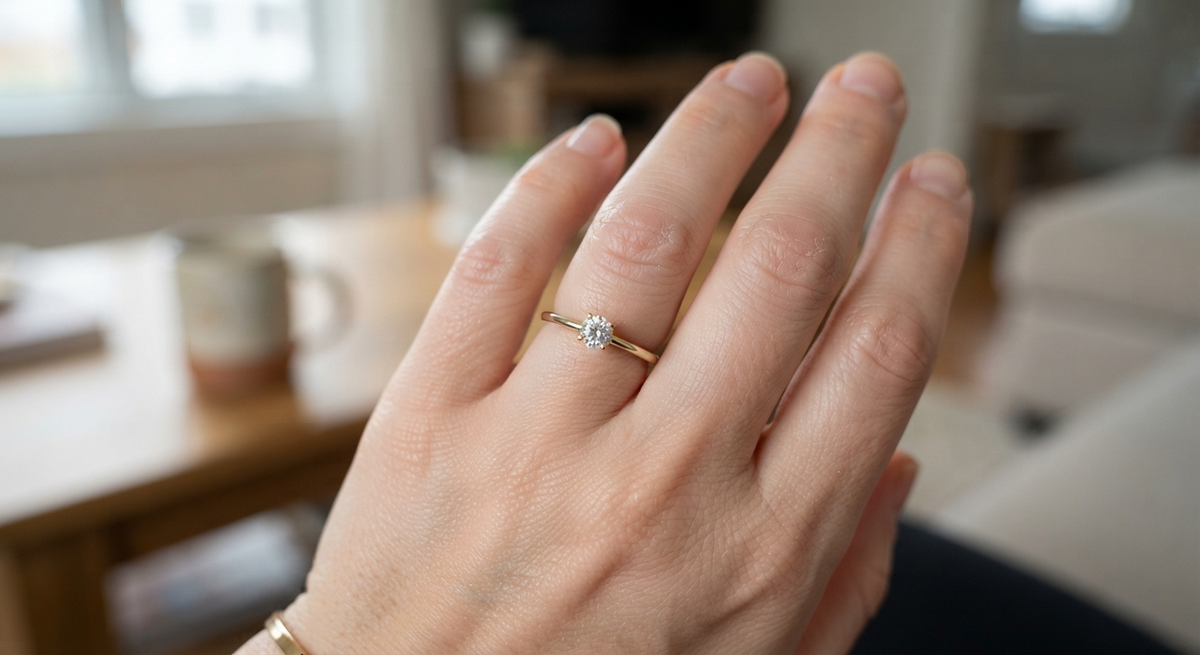
A ring can look smaller than expected for several reasons, including its diamond or gemstone shape, setting style, band width, finger proportions, lighting, viewing angle, and expectations based on photos or online images.
A ring's visual size is not determined only by its carat weight or physical dimensions. Two rings with similarly sized centre stones can look dramatically different on the hand because of their proportions and design.
In 2026, ring styling continues to emphasize proportion, balanced settings, refined details, and personalised design rather than simply choosing the largest possible centre stone.
If your ring looks smaller than you imagined, that doesn't necessarily mean you chose the wrong ring. Understanding the factors that affect perceived size can help you see why the ring looks different on your hand than it did online or in your imagination.
Key Takeaways
- A ring's carat weight does not determine its entire visual appearance.
- Diamond and gemstone shapes can make stones appear longer, wider, or more compact.
- A thick band can make the centre stone appear smaller by comparison.
- Certain settings expose more of the stone and can create a larger-looking appearance.
- Finger size and proportions influence how large a ring appears.
- Lighting and photography can make jewellery look significantly different.
- Halo settings, elongated shapes, and slimmer bands can enhance perceived size.
- A ring can look smaller immediately after purchase because expectations are often influenced by enlarged product photography.
- Proportion matters more than simply choosing a higher carat weight.
- The best-looking ring is one that balances the centre stone, setting, band, and your hand.
Quick Answer: Why Does My Ring Look Smaller Than Expected?
Your ring may look smaller than expected because perceived size depends on more than the stone's carat weight.
The most common reasons include:
- The diamond or gemstone has different face-up dimensions than expected.
- The setting makes the stone appear more compact.
- The band is wider than you imagined.
- Your finger proportions change the visual scale of the ring.
- Product photography made the ring appear larger.
- Lighting conditions affect how much sparkle and surface area you notice.
- You were expecting a larger visual presence based on carat weight alone.
For example, a 1-carat elongated oval diamond can look noticeably different from a 1-carat round diamond, even though both have the same carat weight.
The important distinction is between actual size and perceived size.
A ring may be exactly the size you ordered while still looking smaller than you expected.
Who Is This Guide For?
This guide is useful if you:
- Recently purchased an engagement ring
- Feel that your new ring looks smaller than expected
- Are comparing your ring with online photos
- Are shopping for a diamond ring in 2026
- Want a ring that looks larger without dramatically increasing the budget
- Are unsure how carat weight affects visual size
- Want to understand diamond proportions
- Are comparing different engagement ring settings
- Want to choose a stone that looks substantial on the hand
- Are deciding between different diamond shapes
- Want to make a future ring purchase with greater confidence
Introduction
Few jewellery purchases create stronger expectations than a ring.
You may spend weeks looking at photographs, comparing carat weights, studying different settings, and imagining how the finished piece will look on your hand.
Then the ring arrives.
You put it on.
And something feels different.
"Why does my ring look smaller than I expected?"
This is more common than many people realise.
The reason is that the visual size of a ring is influenced by many factors beyond the number written on the certificate or product page.
A diamond's carat weight tells you its weight, not exactly how large it will appear from the top.
Likewise, a ring's centre stone doesn't exist visually on its own. The band, setting, side stones, finger size, proportions, lighting, and surrounding space all influence how your eye perceives it.
A ring can therefore look surprisingly different on the hand compared with how you imagined it.
The good news?
There are several understandable reasons for this.
Here are 7 surprising reasons your ring may look smaller than expected in 2026—and what you can do about it.
What Determines How Large a Ring Looks?
Before exploring the individual reasons, it helps to understand the difference between physical measurements and visual impact.
A ring's perceived size can be influenced by:
- Centre stone dimensions
- Carat weight
- Diamond shape
- Cut proportions
- Setting style
- Band width
- Side stones
- Finger size
- Finger shape
- Metal colour
- Lighting
- Photography
- Viewing distance
- Overall ring proportions
This means that two rings with the same carat weight can look completely different when worn.
Think of the ring as a complete composition.
Stone + setting + band + finger = overall visual appearance
That is why choosing a ring based on carat weight alone can sometimes lead to unexpected results.
7 Surprising Reasons Your Ring Looks Smaller Than Expected
1. Carat Weight Isn't the Same as Visual Size
Does a Higher Carat Always Look Bigger?
Not necessarily.
One of the biggest misconceptions about diamonds is assuming that carat weight directly equals visible size.
Carat refers to weight, while the dimensions of a diamond determine how much surface area you see when looking at it from above.
Two diamonds can have the same carat weight but different measurements.
For example, a deeper-cut stone may carry more of its weight below the surface, while another stone may have proportions that make it appear broader from the top.
This means:
Same carat weight ≠ identical visual size
When shopping for a diamond, pay attention to the stone's length and width measurements, not only its carat weight.
Why This Matters
Imagine two diamonds that both weigh 1 carat.
One may look relatively compact from the top.
Another may have a larger face-up appearance because of its shape and proportions.
Your eyes see the surface area first—not the number on the certificate.
Quick tip: When comparing diamonds, look at the millimetre dimensions alongside carat weight.
2. Your Diamond Shape May Make It Look Smaller
Why Do Some Diamond Shapes Look Bigger Than Others?
Diamond shape has a major effect on perceived size.
Different shapes distribute their weight differently and create different visual outlines.
Some popular shapes include:
- Round
- Oval
- Emerald
- Pear
- Marquise
- Cushion
- Radiant
- Princess
Elongated shapes such as oval, pear, and marquise can create a larger-looking appearance because they cover more visual space along the length of the finger.
A round diamond, by comparison, creates a more compact outline.
This doesn't mean one shape is objectively better.
It simply means that different shapes create different visual effects.
The Finger Coverage Effect
Finger coverage refers to how much visible area the ring occupies across the finger.
An elongated stone can extend farther across the finger, making it feel visually substantial even when the carat weight isn't dramatically higher.
That's why someone may choose an elongated diamond when their priority is a larger-looking appearance.
3. Your Ring Band May Be Making the Centre Stone Look Smaller
Can a Thick Band Make a Diamond Look Smaller?
Yes.
This is one of the most overlooked factors.
A wider band naturally occupies more visual space around the centre stone.
As a result, the centre stone can appear smaller by comparison.
For example:
Slim band + centre stone = stronger stone emphasis
while:
Wide band + same centre stone = more balanced visual proportions
Neither design is wrong.
A wider band can create a bold, substantial, modern appearance.
But if your priority is making the centre stone look as prominent as possible, a slimmer band can create more contrast.
The Proportion Principle
The perceived size of your centre stone is partly about relative scale.
The smaller the surrounding elements appear, the more prominent the centre stone can become.
That's why delicate engagement ring bands remain popular for people who want their centre stone to be the visual focal point.
4. The Setting Can Change the Ring's Visual Presence
Does Ring Setting Affect How Big a Diamond Looks?
Absolutely.
The setting determines how much of the stone is visible and how the centre stone interacts with the band.
Common engagement ring settings include:
- Solitaire
- Halo
- Pavé
- Bezel
- Three-stone
- Cathedral
- Cluster
- Hidden halo
A solitaire setting, for example, places most of the visual attention on the centre stone.
A halo setting surrounds the centre stone with smaller stones, creating additional surface area and sparkle.
This can make the overall ring look larger.
A bezel setting, on the other hand, surrounds the edge of the stone with metal, which can create a more structured appearance.
Setting Height Matters Too
A higher setting can sometimes make the centre stone feel more visually prominent because more of the stone is exposed.
However, a higher setting isn't automatically better.
The ideal setting depends on:
- Stone shape
- Ring style
- Wearability
- Finger proportions
- Personal preference
- Desired visual effect
The goal is to find a setting that enhances the stone rather than simply making it appear larger.
5. Your Finger Size and Proportions Affect Perceived Size
Why Does the Same Ring Look Different on Different Hands?
Because the surrounding visual space changes.
A ring placed on a slender finger may appear more substantial because the stone occupies a larger percentage of the visible finger width.
On a wider finger, the same ring may appear more delicate.
This doesn't mean the ring itself has changed.
The visual relationship between the ring and the finger has changed.
Consider:
Small finger + medium centre stone = strong visual coverage
versus:
Larger finger + same centre stone = more negative space
This is one reason online try-on images can sometimes be misleading.
A ring shown on a model's hand may look different when worn by you.
Don't Compare Your Hand Directly With Someone Else's
If your ring looks different from a photograph online, don't immediately assume the ring is too small.
Compare:
- Finger width
- Finger length
- Ring size
- Camera distance
- Stone dimensions
- Band width
These variables can dramatically change visual perception.
6. Lighting and Photography Can Change Everything
Why Did My Ring Look Bigger Online?
Photography is one of the biggest reasons jewellery can look different in person.
Professional product photography often uses:
- Controlled lighting
- Macro lenses
- Close-up framing
- Carefully selected angles
- High-resolution images
- Reflective surfaces
These techniques can emphasise the stone's sparkle and visual presence.
Your phone camera may produce a completely different result.
Lighting also matters.
A diamond under bright, directional light can produce intense flashes of brilliance.
Under softer indoor lighting, it may appear less dramatic.
This doesn't necessarily mean the diamond has changed.
The environment has changed.
Camera Perspective Matters
A close-up photograph can make a ring appear significantly larger than it looks from normal viewing distance.
The same ring photographed from farther away will appear more proportional.
That's why it is useful to look at both:
- Close-up product images
- On-hand photographs
- Videos
- Real-world customer images when available
A photograph should be treated as a styling reference, not an exact representation of how large the ring will look on your hand.
7. Your Expectations May Have Been Larger Than the Actual Ring
Why Does My Ring Look Smaller Even Though I Chose the Size I Wanted?
Sometimes the issue isn't the ring.
It's expectation.
When shopping online, you may repeatedly see enlarged photographs of diamonds and jewellery.
You might also compare your ring with:
- Celebrity rings
- Social media posts
- Influencer content
- Close-up jewellery videos
- Enlarged product photography
- Rings worn by people with different hand proportions
Over time, your brain starts to associate a certain visual image with a specific carat weight.
Then your real ring arrives.
It looks normal—but not as dramatic as the images you've been viewing.
This is sometimes called a perception gap.
The ring hasn't necessarily failed to meet its specifications.
Your mental reference point may simply have been different from reality.
Does Ring Carat Weight Determine How Big It Looks?
Carat weight is important, but it shouldn't be the only factor you consider.
A diamond's visual size is affected by its:
- Carat weight
- Length
- Width
- Depth
- Shape
- Cut proportions
- Setting
For example, two stones with the same carat weight can have different face-up dimensions.
That's why comparing millimetre measurements can be extremely helpful when you're focused on visual size.
Carat vs Visual Coverage
Think of it this way:
Carat = how much the stone weighs
Millimetres = how much surface area you see
Both matter, but they answer different questions.
If your primary concern is how large the stone looks on your finger, visual dimensions deserve serious attention.
How Can I Make My Ring Look Bigger?
If your ring looks smaller than expected, there are several styling and design approaches that can enhance its visual presence.
Choose a Slimmer Band
A delicate band can create stronger contrast around the centre stone.
This can make the stone appear more prominent.
Consider an Elongated Diamond Shape
Oval, pear, marquise, and some elongated radiant or emerald shapes can provide strong finger coverage.
The exact appearance depends on the stone's proportions.
Consider a Halo Setting
A halo surrounds the centre stone with smaller stones.
This adds visual width and sparkle around the centre.
Use Pavé Details
Pavé stones along the band can increase overall sparkle and create a more jewellery-forward appearance.
Choose a Three-Stone Design
Three-stone rings can create substantial finger coverage without relying entirely on one large centre stone.
Focus on Proportion
Instead of simply increasing the centre stone size, consider the relationship between:
Centre stone + band + setting + finger
A well-proportioned ring can look more impressive than a larger stone placed in a less balanced design.
What Ring Styles Make a Diamond Look Bigger?
Different styles create different visual effects.
Solitaire Ring
A solitaire places almost all attention on the centre stone.
Best for: Making the centre stone the clear focal point.
Halo Ring
A halo surrounds the centre stone.
Best for: Creating additional visual width and sparkle.
Pavé Ring
Small stones decorate the band.
Best for: Increasing overall brilliance.
Three-Stone Ring
Multiple stones create horizontal coverage.
Best for: A more substantial overall appearance.
Elongated-Cut Ring
Shapes such as oval or marquise can create strong finger coverage.
Best for: A longer, more elongated visual effect.
Why Does My Engagement Ring Look Smaller Than It Did Online?
This is usually caused by a combination of photography, perspective, lighting, and hand proportions.
Online jewellery photography is often captured at close range.
The ring may occupy most of the frame, while your real-life viewing distance is much farther away.
Additionally, a professional model's hand may have different proportions from yours.
The ring can therefore appear smaller even when the dimensions are exactly as advertised.
Before deciding that your ring is too small, compare its actual measurements with the product specifications.
Why Does My Diamond Look Smaller After I Put It on My Finger?
This can happen because your finger provides a much larger visual context than the close-up image you may have seen online.
When you look at a diamond by itself, your eye focuses almost entirely on the stone.
Once it is mounted on your finger, your brain compares it with:
- The band
- Your finger
- Your hand
- Other jewellery
- Surrounding space
This changes its perceived scale.
It's similar to how a small object can look large in a close-up photograph but much smaller when placed in a wider scene.
Can a Ring Look Bigger Without Increasing Carat Weight?
Yes.
You don't always need a larger centre stone.
You can increase perceived visual presence through:
- Elongated diamond shapes
- Slimmer bands
- Halo settings
- Pavé details
- Side stones
- Stronger finger coverage
- Appropriate setting proportions
- Contrasting metal details
The goal is to improve visual impact, not simply increase weight.
Diamond Shape Comparison for Perceived Size
| Diamond Shape | General Visual Effect | Finger Coverage |
|---|---|---|
| Round | Classic and balanced | Moderate |
| Oval | Elongated appearance | Strong |
| Marquise | Long and narrow | Very strong |
| Pear | Elongated and directional | Strong |
| Emerald | Long, elegant outline | Strong |
| Radiant | Bold and brilliant | Strong |
| Cushion | Softer, fuller outline | Moderate |
| Princess | Crisp, geometric appearance | Moderate |
These are general visual tendencies rather than guarantees. Individual stone proportions can significantly change the final appearance.
How Band Width Changes Ring Appearance
Band width is often overlooked when choosing an engagement ring.
A very delicate band can make the centre stone appear more dominant.
A medium band can create a balanced, classic appearance.
A wider band can create a stronger, more substantial design.
For example:
Slim band + large centre stone
creates a strong centre-stone focus.
While:
Wide band + medium centre stone
creates a more balanced overall composition.
Neither is better.
The right choice depends on whether you want the ring to feel:
- Delicate
- Classic
- Bold
- Contemporary
- Substantial
- Minimal
Common Mistakes That Make a Ring Look Smaller
Choosing Based Only on Carat Weight
Carat weight doesn't tell the entire visual story.
Better: Compare millimetre dimensions and proportions.
Ignoring Band Width
The band can dramatically change the visual relationship between the stone and the ring.
Better: Consider the complete ring design.
Comparing Your Ring With Enlarged Photos
Close-up photography can distort your perception of scale.
Better: Look for on-hand images and videos.
Choosing a Shape Without Considering Finger Coverage
Different shapes create different visual outlines.
Better: Compare the actual dimensions of the stones.
Focusing Only on Centre Stone Size
A ring's overall appearance comes from the complete composition.
Better: Consider the setting, band, side stones, and proportions together.
Assuming Bigger Always Means Better
A larger centre stone isn't automatically more attractive.
Better: Prioritise balance, quality, comfort, and personal style.
Should You Be Worried If Your Ring Looks Smaller Than Expected?
Not necessarily.
Before making any decision, check:
- The ring size
- Centre stone carat weight
- Stone dimensions
- Diamond shape
- Band width
- Setting style
- Product photography
- Your expectations
If the ring matches its listed specifications, the difference may simply be visual perception.
However, if the physical measurements don't match what you ordered, that's a different issue and should be addressed with the jeweller.
How to Choose a Ring That Looks Substantial in 2026
If visual size is one of your priorities, focus on proportion rather than numbers alone.
1. Compare Millimetre Measurements
Don't stop at carat weight.
Look at the stone's length and width.
2. Consider Elongated Shapes
Oval, pear, marquise, and other elongated shapes can create strong visual coverage.
3. Pay Attention to Band Width
A slimmer band can increase the apparent prominence of the centre stone.
4. Look at the Complete Setting
A halo, pavé, or side-stone design can change the overall visual impact.
5. Look at On-Hand Images
Whenever possible, see the ring worn on an actual hand.
6. Consider Your Own Finger Proportions
A ring should be evaluated in relation to your hand rather than someone else's.
7. Think Beyond Size
A beautiful ring is about more than visual scale.
Consider:
- Sparkle
- Cut quality
- Comfort
- Durability
- Proportion
- Personal style
- Everyday wearability
Ring Appearance: What Matters Most?
| Factor | Effect on Perceived Size |
|---|---|
| Carat weight | High |
| Length and width | Very high |
| Diamond shape | Very high |
| Band width | High |
| Setting style | High |
| Finger proportions | High |
| Lighting | Moderate to high |
| Photography | High |
| Side stones | Moderate to high |
| Metal colour | Moderate |
This is why choosing a ring based on one specification rarely tells the full story.
Ring Size vs Ring Appearance
Your ring size doesn't determine whether a ring is attractive.
But it can affect how large the centre stone appears relative to your finger.
A smaller ring size can make a particular stone appear more prominent.
A larger ring size can create more surrounding space.
This is another reason why online images should not be treated as an exact prediction of how the ring will look on your hand.
How to Style a Ring to Increase Its Visual Impact
Your other jewellery can also influence how your ring is perceived.
Pair It With Minimal Rings
A simple wedding band can allow the engagement ring to remain the focal point.
Avoid Excessive Visual Competition
Multiple large rings on adjacent fingers can make each piece feel less dominant.
Use Coordinating Jewellery
Simple earrings or a delicate bracelet can keep attention centred on the ring.
Consider Your Nail Styling
Your overall hand presentation can influence the visual appearance of jewellery.
The goal isn't to disguise the ring.
It's to create a balanced visual environment around it.
Is a Smaller-Looking Ring Still a Good Ring?
Absolutely.
A ring doesn't need to look enormous to be beautiful.
In fact, modern jewellery styling increasingly values:
- Proportion
- Elegance
- Wearability
- Personalisation
- Craftsmanship
- Subtle detail
A smaller centre stone can look exceptionally sophisticated when paired with the right setting and band.
The most important question isn't:
"Does my ring look as big as possible?"
It's:
"Does my ring look balanced and feel like me?"
Ring Size Perception: Before and After Purchase
It's useful to separate two different situations.
Before Buying
Focus on:
- Actual measurements
- Stone proportions
- Setting
- Band width
- On-hand images
- Return policies
After Buying
Focus on:
- Whether the specifications match
- Whether the ring fits comfortably
- Whether you like the proportions
- Whether the design suits your style
Don't make an immediate decision based solely on the first impression.
Sometimes a ring begins to look more natural after you wear it for a few days.
Pros and Cons of Choosing a Larger-Looking Ring
| Pros | Cons |
|---|---|
| Stronger visual presence | May require a larger budget |
| More finger coverage | Can become less delicate |
| Can photograph dramatically | Larger stones may require more care |
| Statement-making appearance | May not suit minimalist preferences |
| Can feel visually substantial | Bigger isn't always more comfortable |
The best choice depends on your priorities.
Who Should Consider a Larger-Looking Ring?
A visually substantial ring may appeal to you if you:
- Want strong finger coverage
- Prefer statement jewellery
- Enjoy bold engagement ring styles
- Want the centre stone to be highly noticeable
- Prefer elongated diamond shapes
- Like halo or three-stone designs
- Want your ring to photograph prominently
A more understated design may be better if you:
- Prefer minimalist jewellery
- Want everyday comfort
- Like delicate designs
- Prefer subtle elegance
- Don't want the ring to dominate your hand
There is no universally correct ring size.
How to Check Whether Your Ring Is Actually Smaller Than Expected
If you're concerned that your ring may not match what you ordered, follow these steps.
Step 1: Check the Product Specifications
Look at:
- Centre stone carat weight
- Stone measurements
- Ring size
- Band width
- Setting details
Step 2: Compare the Actual Measurements
Don't rely only on photographs.
Step 3: Compare With Your Original Order
Make sure the ring you received matches the specifications you purchased.
Step 4: Consider Photography
Ask whether your original expectations came from close-up or enlarged images.
Step 5: Evaluate the Ring on Your Hand
Look at it from normal viewing distance rather than only extremely close.
Step 6: Contact the Jeweller If Something Doesn't Match
If the physical specifications differ from your order, contact the jeweller for clarification.
Frequently Asked Questions About Ring Size and Appearance
Why Does My Ring Look Smaller Than Expected?
Your ring may look smaller because of the diamond's proportions, shape, setting, band width, finger size, lighting, photography, or expectations based on enlarged images.
Does Carat Weight Equal Diamond Size?
No. Carat measures weight, not the exact face-up dimensions of a diamond. Length, width, depth, and proportions also influence how large the stone appears.
What Diamond Shape Looks Biggest?
Elongated shapes such as oval, marquise, pear, and some elongated radiant or emerald cuts can create strong visual coverage. However, individual proportions matter.
Does a Thin Band Make a Diamond Look Bigger?
A slimmer band can make the centre stone appear more prominent because there is greater visual contrast between the band and the stone.
Does a Halo Make a Ring Look Bigger?
A halo can make the overall ring appear larger by surrounding the centre stone with additional smaller stones.
Why Does My Engagement Ring Look Bigger in Photos?
Close-up photography, lighting, camera perspective, and framing can all make jewellery appear more substantial than it does at normal viewing distance.
Can Finger Size Affect How Big a Ring Looks?
Yes. The same ring can look different on different fingers because the surrounding finger width and proportions change the visual relationship between the ring and the hand.
Should I Choose a Larger Carat If I Want a Bigger-Looking Ring?
Not necessarily. You can sometimes increase perceived size through diamond shape, proportions, band width, halo settings, pavé details, or side stones without simply increasing carat weight.
Is a Smaller Ring Less Elegant?
No. A smaller centre stone can look extremely elegant when the ring has balanced proportions and a well-designed setting.
How Can I Make My Existing Ring Look Bigger?
You can explore styling options such as a slimmer band, complementary stacking bands, a halo-style design, or other setting changes where appropriate. Any structural modification should be discussed with a qualified jeweller.
Should I Compare My Ring With Social Media Photos?
Use social media as inspiration rather than an exact measurement reference. Photography, editing, lighting, hand proportions, and camera distance can all affect perceived size.
Final Verdict: Why Does Your Ring Look Smaller Than Expected?
If your ring looks smaller than expected, you're not necessarily looking at a problem with the ring.
The visual size of a ring is influenced by far more than its carat weight.
Diamond shape, stone dimensions, setting style, band width, finger proportions, lighting, photography, and expectations all contribute to how large the ring appears.
The seven biggest reasons are:
- Carat weight isn't the same as visual size
- Diamond shape changes perceived coverage
- Band width affects the centre stone's prominence
- The setting changes the overall visual impact
- Finger proportions influence perceived scale
- Lighting and photography can exaggerate size
- Your expectations may have been influenced by enlarged images
If you're choosing a new ring, look beyond the carat number.
Compare the millimetre dimensions, shape, setting, band width, and overall proportions.
And if you've already purchased your ring, give yourself time to see it in different lighting and with different outfits before deciding that it looks too small.
The most beautiful ring isn't necessarily the one that looks largest.
It's the one where the stone, setting, band, and your hand work together in perfect proportion.
The ultimate goal is simple: choose a ring that looks balanced, feels comfortable, reflects your style, and makes you happy every time you look at your hand.

