
Cart
0
|
AUVERA CRAFT Handcrafted Fine Jewelry · Jewelry Guide · 2026 |
What Is a Cluster Ring?
A Simple Guide to This Sparkling Jewelry Style

Not every beautiful ring needs a single large stone at its center. Some of the most breathtaking pieces in fine jewelry get their sparkle from an entirely different approach — and the cluster ring is one of the best examples of that.
If you have ever looked at a ring and thought it looked like a bouquet of light, you were probably looking at a cluster ring.
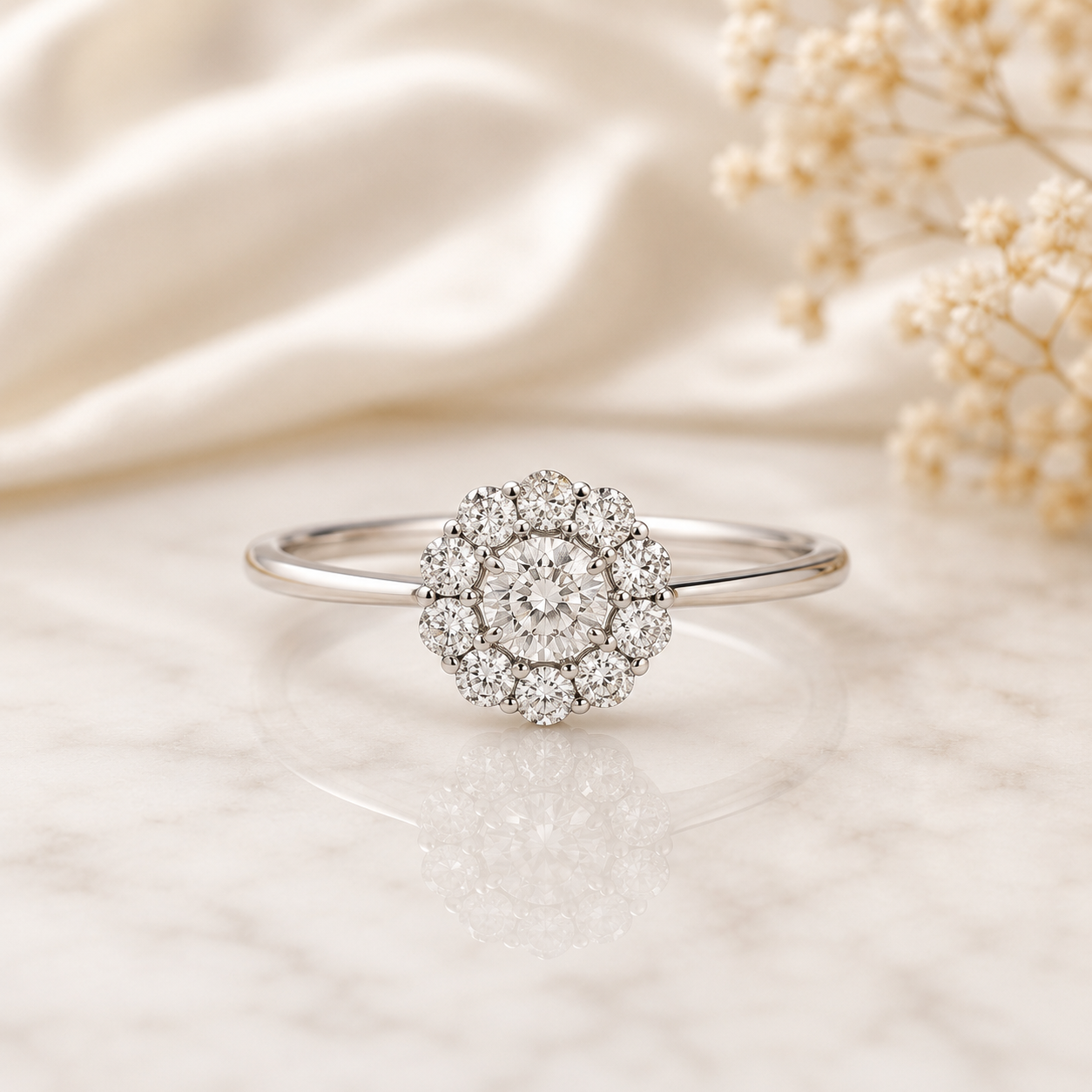
The name says exactly what it is. Instead of one large center stone sitting alone in a setting, a cluster ring brings together a group of smaller stones — diamonds, colored gemstones, or a combination of both — arranged closely together to create a single, unified design. The result is a ring that often looks larger, more intricate, and more distinctive than a single-stone ring at the same price point.
Cluster rings have been around for centuries. They were popular in the Georgian and Victorian eras, fell in and out of fashion through the twentieth century, and are now having a genuine moment in 2026 — particularly among buyers who want something that feels personal, artistic, and unlike anything they have seen on anyone else's hand.
This guide explains what cluster rings are, the different styles available, how they compare to solitaire and halo rings, and who they tend to suit best.
What Exactly Makes a Ring a Cluster Ring?

A cluster ring is any ring where multiple smaller stones are grouped together in a single setting, designed to be read as one unified shape rather than a collection of individual gems.
The stones might be arranged in a circular pattern, a floral shape, a geometric design, or something completely freeform and asymmetrical. They might all be the same cut, or they might mix different shapes for a more layered, artistic look. What defines a cluster ring is not the specific arrangement — it is the underlying idea of many stones working together as one.
This design approach has one very practical advantage that makes it popular with buyers at all budget levels. Multiple smaller stones combined together deliver more total surface area — and therefore more sparkle — than a single stone of equivalent weight. A cluster ring can genuinely outshine a solitaire of the same carat total, simply because more facets are catching the light from more angles at once.
The Main Types of Cluster Rings

Cluster rings come in a wide range of styles. Here are the main ones you will encounter when shopping:
✦ FLORAL
Floral Cluster Rings
One of the most enduring cluster ring designs arranges smaller stones in the shape of a flower — typically with one stone at the center and a ring of petals around it, each petal formed by a single stone. This style has roots in the Georgian and Victorian eras, and it remains one of the most recognizable and loved cluster designs today. Floral cluster rings have a distinctly romantic, feminine quality that suits partners who love vintage-inspired jewelry with a soft, natural feel.
✦ STARBURST
Starburst Cluster Rings
A starburst or sunburst cluster radiates stones outward from a central point, creating a bold, graphic shape that reads as both vintage and modern at the same time. This design tends to be more angular and striking than a floral cluster and suits partners who like jewelry with real presence and visual drama.
✦ GEOMETRIC
Geometric Cluster Rings
Rather than organic shapes, geometric cluster rings arrange stones in precise patterns — hexagons, diamonds, rectangles, and other angular forms. This style draws heavily on Art Deco influence and feels thoroughly modern despite its historical roots. In 2026, geometric cluster rings are particularly popular among buyers looking for something architectural and clean.
✦ ASYMMETRICAL
Asymmetrical Cluster Rings
The most on-trend cluster style of 2026. Asymmetrical clusters break away from symmetry entirely, combining stones of different shapes, sizes, and sometimes colors in arrangements that feel deliberate but not predictable. Pinterest and Instagram search data from early 2026 show a significant rise in interest for asymmetrical cluster designs as buyers move away from traditional halos toward something more personal and artistic.
✦ VINTAGE
Vintage Cluster Rings
Inspired directly by antique pieces from the Georgian, Victorian, and Edwardian eras, vintage cluster rings feature intricate metalwork, milgrain edging, and stone arrangements that feel genuinely historical. These rings appeal strongly to buyers who want something that looks like it has a story behind it — and in many cases, it does.
Cluster Ring vs Solitaire Ring — What Is the Difference?

This is one of the most common questions buyers ask, and the answer comes down to three things: design, value, and personality.
A solitaire ring places one diamond or gemstone at the center of everything. The stone is the entire statement. The setting exists simply to hold and display it. Solitaires are timeless, universally flattering, and the most searched engagement ring style in the USA.
A cluster ring distributes the visual interest across multiple stones. No single stone dominates — instead, the arrangement itself becomes the focal point. The ring tells a more complex visual story.
From a value perspective, cluster rings often deliver more sparkle per dollar than solitaires. Getting a single diamond large enough to make a statement in a solitaire setting costs significantly more than grouping several smaller stones of equivalent total weight. Many buyers find that a well-designed cluster ring delivers the visual impact they want at a price point that works better for their budget.
From a personality perspective, solitaires tend to suit people who appreciate simplicity and timelessness. Cluster rings tend to suit people who want something with more character, more detail, and a design that feels genuinely their own.
Cluster Ring vs Halo Ring — Are They the Same Thing?

This question comes up frequently because both styles involve multiple stones. The answer is that they are related but not the same.
A halo ring has a clear structure: one prominent center stone with a ring of smaller accent stones surrounding it. The center stone is always the main event. The halo exists to amplify it.
A cluster ring does not necessarily have a dominant center stone at all. In many cluster designs, all the stones are roughly the same size, and the arrangement itself is the feature rather than any single gem. In others, a slightly larger stone sits at the center but the surrounding stones are still part of the primary design rather than a secondary accent.
Think of it this way — all halo rings are a type of cluster ring, but not all cluster rings are halos. A halo has a specific formula. A cluster ring is a broader category that includes the halo but goes well beyond it.
Who Is a Cluster Ring Right For?

Cluster rings are not for everyone — and that is actually part of their appeal. They suit a specific kind of buyer, and when the match is right, the result is a ring that feels completely personal.
A cluster ring is likely the right choice if your partner:
— Prefers jewelry with personality and detail over clean, minimalist designs. Cluster rings reward close inspection — there is always more to see the longer you look.
— Is drawn to vintage, antique, or one-of-a-kind pieces. The historical roots of cluster ring design give these pieces an heirloom quality that mass-produced solitaires often lack.
— Wants maximum sparkle without a large budget for a single stone. Cluster rings deliver impressive brilliance at price points that many buyers find more accessible than comparable solitaires.
— Has an artistic or creative sensibility. Cluster rings, particularly asymmetrical and geometric designs, appeal strongly to people who see jewelry as a form of personal expression.
— Wants something that no one else is wearing. With the surge in interest in asymmetrical and bespoke cluster designs in 2026, the most distinctive cluster rings remain genuinely unusual.
Are Cluster Rings Practical for Everyday Wear?
This is a fair question and one worth addressing honestly.
Cluster rings with well-executed settings — particularly bezel or prong settings — hold up very well to daily wear. The key is the quality of the setting. A poorly made cluster ring where stones are held by delicate prongs can lose individual stones over time, particularly if the wearer works with their hands.
When buying a cluster ring for everyday use, look for settings where each stone is held securely. Bezel settings, where a thin rim of metal wraps around each stone, are the most durable option. Well-crafted prong settings work well too. Avoid overly delicate pavé-style mounts for rings that will be worn constantly, as these require more maintenance over time.
At Auvera Craft, every cluster ring we make is built with daily wear in mind. We are always happy to discuss setting options and which styles suit particular lifestyles before you buy.

|
Quick Facts About Cluster Rings What is a cluster ring — Multiple smaller stones grouped together to form a single unified design Are cluster rings real diamonds — Yes, if they contain diamonds they are genuine Are cluster rings good value — Generally yes, they deliver more sparkle per carat than solitaires Can cluster rings be engagement rings — Absolutely, and they are increasingly popular for exactly that purpose Are cluster rings trending in 2026 — Yes, particularly asymmetrical and geometric styles Hardest cluster ring to resize — Full cluster bands where stones wrap around the entire ring |
Got questions? Our team is happy to walk you through it personally.
|
Explore Cluster Rings at Auvera Craft We create cluster rings in a range of styles — from classic floral designs to bold geometric arrangements and fully bespoke asymmetrical pieces built around your vision. If you are drawn to this style, our team would love to help you design something entirely your own. |
© 2026 Auvera Craft · Handcrafted Fine Jewelry · USA

